In This Article
3D pen filament refills are replacement lengths of thermoplastic, usually PLA, ABS or PCL, that feed into a 3D pen’s heated nozzle so you can keep drawing in three dimensions. The right 3D pen filament refills match your pen’s diameter, melting range and material. That is why compatibility matters far more than the number of colours on the box.
Here’s the thing nobody tells you when you unwrap a shiny new pen. The starter filament vanishes astonishingly fast. Kids, in particular, can chew through a starter pack in a single afternoon. Then comes the refill hunt, and that’s where it goes wrong. Plenty of listings look identical, yet a 1.75mm PLA strand will not fit a pen built for 2.5mm or 3mm plastic, and a low-temperature pen can choke on the wrong material.
This guide separates the genuinely useful from the merely colourful. It covers seven real refill options, from budget-friendly PLA filament refills for 3D pens to the proprietary plastics that 3Doodler’s pens demand. PLA itself is a plant-derived polyester with a modest melting range, which explains why it suits hobby pens so well. It also has poor heat resistance, which is why a finished doodle left on a sunny car dashboard can sag.
Everything below is analysis based on published specifications, retailer listings and aggregated buyer feedback. Nothing is based on invented testing. Where reviews couldn’t be verified, we say so. We also cover PLA compatibility, colour mixing and filament diameter sizing in dedicated sections, plus a practical multipack buying guide. Prices appear as ranges only, so check current price on amazon.co.uk before you buy.
Quick Comparison: 3D Pen Filament Refills at a Glance
Before the deep dive, here’s the short version. Every 3D pen filament refills option in this guide is listed with the diameter it needs and the kind of buyer it suits best.
| Product | Diameter | Pack Style | Best For |
|---|---|---|---|
| SCRIB3D 20-Colour Refills | 1.75mm PLA | 20 colours, about 100m in total | Best for all-round 1.75mm pens |
| Wiseten 20-Colour Refills | 1.75mm PLA | 20 colours, about 100m in total | Best for pen-and-printer households |
| TekDeals 20-Colour Refills | 1.75mm PLA | 20 colours, 5m each | Best for budget-conscious creators |
| WOIYIC 30-Colour Pack | 1.75mm PLA | 30 colours, 3m each | Best for colour mixing experiments |
| Kretrum 28-Colour Pack | 1.75mm PLA | 28 colours incl. glow and sparkle | Best for special-effect fans |
| 3Doodler Create+ Plastic | 3mm PLA, ABS and FLEXY | 25-strand packs | Best for owners of the Create+ pen |
| 3Doodler Start+ Eco-Filament | 2.5mm eco-plastic | 24-strand and larger packs | Best for younger children |
The table shows a clear split. Five of the seven are open-standard 1.75mm PLA, and the SCRIB3D 20-Colour Refills, Wiseten 20-Colour Refills and TekDeals 20-Colour Refills all aim at the same buyer. If you own a pen from a 3Doodler range, only the final two entries matter, because 3Doodler’s plastics use different diameters and are not interchangeable with the others. Budget buyers should also notice that the WOIYIC 30-Colour Pack and Kretrum 28-Colour Pack trade metres per colour for sheer variety.
💬 Just one click — help others make better buying decisions too!😊
Top 7 3D Pen Filament Refills: Expert Analysis
1. SCRIB3D 20-Colour Refills — the dependable all-rounder for 1.75mm pens
The SCRIB3D 20-Colour Refills are the closest thing the category has to a default choice. The bundle offers 20 assorted colours and a little over 328 feet (about 100 metres) of 1.75mm PLA in total, which works out at roughly 16 feet per colour. The listings quote a working range of around 160°C to 210°C, with a US retailer’s version stating 320-410°F.
What does that mean in practice? Sixteen feet is enough for a few small models in each shade rather than a single token doodle. The wide temperature window also gives you room to tune the flow. Start low for a firm, controlled bead and creep upwards if the plastic feels sluggish. The listings say it suits SCRIB3D, PIKA3D and MYNT3D pens and, importantly, that it will not fit 3Doodler Create+ pens.
Based on the spec comparison, this is the sensible first purchase for anyone with an open-standard pen. Review themes on comparable 320-foot assortments are fairly consistent. Buyers praise the colour variety and note that PLA wants a lower pen temperature than ABS, so check your manual first. A few reviewers flagged mislabelled listings, so confirm the pack says “3D pen” and not “3D printer”.
Pros:
- ✅ Generous 16 feet per colour
- ✅ Wide, forgiving temperature window
- ✅ Works across several popular pen brands
Cons:
- ❌ Not compatible with 3Doodler Create+ pens
- ❌ Listing age guidance starts at 14+
Price range: typically around the £15-£30 bracket, so check current price. Verdict: strong value for the metres you get.
2. Wiseten 20-Colour Refills — a pen-and-printer crossover pack
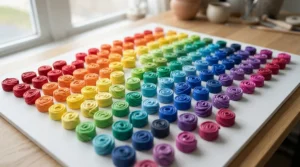
The Wiseten 20-Colour Refills pitch themselves as a dual-use pack. The listing describes 20 colours at 16.4 feet each, 328 feet in total, in 1.75mm PLA that fits both 3D pens and 3D printers using that diameter. It is described as starch-based, odourless and non-toxic, which are manufacturer claims worth treating as a starting point rather than gospel.
The quoted temperature range runs from 190°C to 220°C. That sits noticeably higher than the 160-210°C windows on some rivals. The practical lesson is that you should never trust a single number across brands. Check your pen’s dial, begin at the lower end, and step up only if the plastic extrudes reluctantly.
On paper this suits households with both a pen and a small printer. Short offcuts from printer spools could in theory feed the pen too, though pens struggle with thick stiff lengths. I couldn’t verify a meaningful pool of independent UK reviews for this exact bundle, so treat the claims as seller statements until you’ve read recent buyer feedback on the listing.
Pros:
- ✅ Same 328 feet as pricier bundles
- ✅ Suits both pens and 1.75mm printers
- ✅ Bright, varied 20-colour range
Cons:
- ❌ Independent review depth is thin
- ❌ Higher quoted temperature range may overheat gentler pens
Price range: usually in the £10-£25 bracket, though third-party prices wobble. Verdict: sensible value if you want crossover flexibility.
3. TekDeals 20-Colour Refills — tight tolerances on a tight budget
The TekDeals 20-Colour Refills lead with accuracy. The listing quotes a diameter tolerance of ±0.02mm, and each of the 20 colours gives 5 metres, for 323 feet overall. Colours include cyan, fuchsia, gold, fluorescent green and a transparent strand.
Why should you care about 0.02mm? Because a strand that wanders in thickness is the classic cause of stuttering feeds and sudden clogs. A tighter tolerance means a steadier bead, particularly on cheaper pens with fussy feed mechanisms. Having a transparent and a fluorescent strand in the mix also opens up layering effects, which we cover in the colour mixing section.
In terms of buyer sentiment, a US retailer listing showed roughly 4.5 stars across a few dozen ratings, and one parent mentioned that their son enjoyed the colour variety with a Scrib3d pen. That is a small sample, so read it as encouraging rather than conclusive. Check that the listing you choose on amazon.co.uk matches this specification.
Pros:
- ✅ Quoted ±0.02mm diameter tolerance
- ✅ Includes transparent and fluorescent strands
- ✅ Good value per metre
Cons:
- ❌ Small pool of verifiable reviews
- ❌ Seller details vary between listings
Price range: toward the budget end, roughly £10-£20. Verdict: the pick for careful spenders.
4. WOIYIC 30-Colour Pack — the widest palette for experimenters
The WOIYIC 30-Colour Pack gives you 30 colours at 3 metres each, 90 metres in total. That breaks down into 24 popular shades, 2 transparent and 4 fluorescent strands. The listing quotes a ±0.02mm tolerance and a 180-210°C printing range, and it explicitly lists compatibility with high-temperature pens such as MYNT3D, SCRIB3D and Acdolf.
Three metres is a modest amount, so this isn’t a bulk-building pack. It is a palette pack. If you like blending shades, layering transparent over solid colours or making small detailed pieces, the 30-colour spread beats a 10-colour pack with longer strands. If you’re making large structures, you’ll run through any single shade quickly.
The listing is blunt about what it won’t suit: low-temperature pens using PCL filament, Filapen pens and 3Doodler’s 2.5mm or 3mm plastics. That honesty is useful. It reinforces the main rule of this guide, which is to check your pen first. I could not verify independent reviews for this exact pack.
Pros:
- ✅ Thirty colours in a single bundle
- ✅ Includes transparent and fluorescent options
- ✅ Clear compatibility warnings on the listing
Cons:
- ❌ Only 3 metres per colour
- ❌ Higher price per metre than 20-colour rivals
Price range: low-£30s on the retailer listing seen, so check current price. Verdict: worth it for colour obsessives, less so for builders.
5. Kretrum 28-Colour Pack — glow, sparkle and fluorescent extras
The Kretrum 28-Colour Pack is the novelty pick. The 28 shades split into 21 popular colours, 3 glow-in-the-dark strands, 3 sparkly strands and 1 fluorescent strand, at roughly 3 metres each. The seller says the plastic is dried for 24 hours and vacuum sealed before packing. It also claims to meet FDA food standards and RoHS, though as with all such statements you should treat them as manufacturer claims.
Special-effect strands behave differently from standard colours in practice. Glow-in-the-dark pigments tend to show best in thicker deposits, and sparkle strands can look dramatic on small accents. Used sparingly on eyes, stars or highlights, they add polish without devouring the pack.
The vacuum sealing is a genuine practical plus. Moisture is the quiet enemy of PLA, and a pack that arrives dry and stays dry is likelier to feed smoothly. The listing states it suits SCRIB3D, MYNT3D and PIKA3D pens and does not fit the 3Doodler Start pen. I couldn’t verify a robust review base for this pack, so check recent buyer comments.
Pros:
- ✅ Glow-in-the-dark and sparkle strands included
- ✅ Vacuum-sealed for moisture protection
- ✅ Broad colour range at 28 shades
Cons:
- ❌ Short 3-metre lengths per colour
- ❌ Safety claims are seller statements only
Price range: mid-range, indicatively £15-£25. Verdict: fun and decent value if effects matter to you.
6. 3Doodler Create+ Plastic — proprietary but purpose-built
The 3Doodler Create+ Plastic is a different animal. Retailer listings put the diameter at 3mm, and packs typically hold 25 strands in PLA, ABS or flexible FLEXY. 3Doodler states that its Create+ plastic is the only plastic compatible with the Create+ pen, which makes this a captive-audience product.
Why pay the premium? Because the pen and plastic are designed together. Stockists describe the PLA as more rigid and well suited to hard edges and sharp angles, and note that it can be used on surfaces such as glass or ceramic. ABS is more flexible and impact resistant, and FLEXY bends. Choosing between them is the real decision here, not choosing between colours.
For structural projects, the PLA strands suit buildings and frames, while ABS fits wearable or knock-about pieces. Based on the specs, the 3Doodler Create+ Plastic pays off for those who already own the pen and want predictable feeding. If you own an open-standard 1.75mm pen, skip it entirely.
Pros:
- ✅ Engineered specifically for the Create+ pen
- ✅ Choice of PLA, ABS and FLEXY
- ✅ Rigid PLA suits sharp structural work
Cons:
- ❌ Useless in 1.75mm pens
- ❌ Higher cost per strand than generic PLA
Price range: roughly £8-£15 per 25-strand pack, indicatively, so check current price. Verdict: essential for Create+ owners, pointless for others.
7. 3Doodler Start+ Eco-Filament — gentle, child-friendly plastic
The 3Doodler Start+ Eco-Filament is built for the Start and Start+ pens. It uses 2.5mm plastic, described by the maker’s stockists as low-heat, BPA-free, non-toxic and compostable. Retailer listings describe bundles from small 24-strand packs up to 500-strand multipacks, and say each strand extrudes about six times its length.
That extrusion claim matters. A single strand producing over 35 inches of line means the thin-looking strands go further than they seem. Bulk bags make particular sense for classrooms, parties and big families where several children share a pen.
The big trade-off is freedom. The Start range is sealed into its own ecosystem, so you can’t swap in cheap 1.75mm PLA. In return, the lower operating temperature is gentler for younger users. For young children, the 3Doodler Start+ Eco-Filament is the one option here designed around that audience. I could not verify a robust UK review base.
Pros:
- ✅ Low-heat design suits younger hands
- ✅ Bulk bags lower cost per strand
- ✅ Compostable material per manufacturer
Cons:
- ❌ Only fits Start and Start+ pens
- ❌ Fewer colour choices than 1.75mm packs
Price range: around £8-£12 for a small pack, with bulk bags costing more overall. Verdict: the family and classroom choice.
How to Choose 3D Pen Filament Refills
What’s the quickest way to choose 3D pen filament refills? Check your pen’s diameter and material first, then pick pack size and colours.
- Confirm your pen’s diameter. Look in the manual or on the pen’s label. Open-standard pens usually take 1.75mm, while 3Doodler uses 2.5mm or 3mm depending on the model. A wrong guess is the most expensive mistake in the category.
- Match the material. Check whether your pen is PLA-only, PLA and ABS, or a low-temperature PCL pen. Using the wrong material risks clogs, or a limp unusable bead.
- Check the temperature window. Seller-quoted ranges vary from 160°C to 220°C, so compare them against your pen’s settings before buying.
- Weigh metres against colours. Twenty colours at five metres each suit builders, while thirty at three suit palette-lovers.
- Look at diameter tolerance. A quoted ±0.02mm is a good sign, since sloppy thickness causes stuttering feeds.
- Read the compatibility warnings. The best sellers tell you what their pack won’t fit. Treat silence as a mild warning.
- Check packaging. Vacuum-sealed packs protect against moisture, and moisture shortens filament life.
PLA Compatibility: Will These Refills Fit Your Pen?
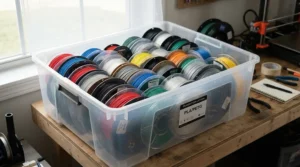
PLA compatibility sounds simple, but it hides three separate questions: material, diameter and temperature. A pen can accept PLA in principle and still reject a particular refill because the diameter is wrong. It can also accept the diameter and still produce a gloopy mess because the heat is wrong.
Start with the pen category. Open-standard pens from SCRIB3D, MYNT3D, PIKA3D and many generics accept 1.75mm filament, and many handle both PLA and ABS. These are the pens served by the first five products in this guide. Pens from 3Doodler are the outliers, because their plastics are proprietary. The Create+ needs its own plastic, and the Start range needs its own eco-filament.
Then check the heat. Wikipedia lists PLA’s melting point at 150-160°C, with a glass transition around 60-65°C. Pen settings run higher because the nozzle must push plastic through a small gap, but the principle stands: PLA is forgiving, which is why it dominates hobby pens. One buyer of a PLA refill pack noted their dual-material pen needed a lower temperature for PLA than for ABS, otherwise they risked a plasticky mess.
A final warning concerns low-temperature PCL pens. Several listings explicitly say their PLA won’t suit them. If your pen runs cool and advertises PCL, buy PCL.
Filament Diameter Sizing: 1.75mm, 2.5mm and 3mm Explained
Filament diameter sizing is the single most important spec on any listing. A refill that is even slightly too thick won’t enter the pen, and a refill that is too thin may slip in the feed gears and stall. The three sizes you’ll meet are 1.75mm for open-standard pens, 2.5mm for the 3Doodler Start range and 3mm for the 3Doodler Create+.
| Product | Diameter | Colours and Length | Quoted Temperature | Best For |
|---|---|---|---|---|
| SCRIB3D 20-Colour Refills | 1.75mm | 20 colours, about 16ft each | 160-210°C | Best for general 1.75mm pens |
| Wiseten 20-Colour Refills | 1.75mm | 20 colours, 16.4ft each | 190-220°C | Best for dual pen and printer use |
| TekDeals 20-Colour Refills | 1.75mm | 20 colours, 5m each | Not specified | Best for tolerance-conscious buyers |
| WOIYIC 30-Colour Pack | 1.75mm | 30 colours, 3m each | 180-210°C | Best for colour variety |
| Kretrum 28-Colour Pack | 1.75mm | 28 colours, about 3m each | Not specified | Best for special effects |
| 3Doodler Create+ Plastic | 3mm | 25-strand packs | Pen-controlled | Best for Create+ owners |
| 3Doodler Start+ Eco-Filament | 2.5mm | 24-strand and bulk packs | Low-heat | Best for young children |
Look at the pattern. Every 1.75mm pack is interchangeable in principle, while the 3Doodler options each serve exactly one pen family. That means the first four 1.75mm products compete on colour count, length and tolerance. Note too that seller temperature ranges differ by up to 30°C for the same material, which is a reminder to rely on your pen’s own settings.
Colour Mixing: Getting More Shades From Fewer Strands
Colour mixing is where a colour 3D pen filament pack earns its keep, and it’s far more flexible than most beginners assume. You don’t need 30 shades to produce 30 looks.
Layering. Draw a thin base in one colour, then add a second over the top. Transparent strands, like those in the TekDeals 20-Colour Refills and WOIYIC 30-Colour Pack, tint whatever lies beneath them, so one clear strand and a handful of solids give you a surprisingly wide palette.
Marbling by twisting. A common hobbyist trick is to twist two short strands together before loading, giving a swirled bead. Results vary by pen, so try it on scrap first. Thin, stiff pens may struggle with the extra thickness, so don’t force it.
Sequential swaps. Feed one colour, extrude it fully, then load the next without stopping. The brief overlap creates a gradient. Keep a few spare inches of each colour to make this easier.
Highlights. A glow strand or sparkle strand from the Kretrum 28-Colour Pack works best as an accent, since a little goes a long way.
The practical lesson? Colour mixing rewards variety over volume, which is why short 3-metre strands suit it perfectly. If you mainly build large structures, favour the 5-metre or 16-foot packs instead.
Practical Usage Guide: Your First 30 Days With Refills
Good habits in the first month save you from most clogs and wasted plastic.
Setup. Check your pen’s manual, set a low temperature, and let the pen heat fully before loading. Feed filament slowly. If it resists, stop and retract rather than forcing it.
First-use tips. Practise on baking paper or a silicone mat before touching anything precious. Short bursts beat long continuous pulls, because stopping mid-bead lets plastic cool in the nozzle.
Optimisation tricks. If the bead feels thin and brittle, nudge the heat up a notch. If it droops or strings, drop it back. Seller ranges differ widely, so your pen’s own dial is the real guide.
Maintenance. Before changing colours, push the old strand fully through. Leaving plastic to cool in the nozzle is the classic cause of the next clog. Store unused strands in their sealed bags, away from damp and sunlight.
Common mistakes. Buying the wrong diameter, setting the heat for ABS while using PLA, and abandoning a hot pen unattended top the list. That last one matters beyond mere convenience. A hot nozzle burns skin instantly, so follow the NHS guidance on burns and scalds: cool a burn under running water for 20 minutes, ideally within three hours, and seek help for burns that are large, deep or on sensitive areas.
Problem → Solution Guide for Common Refill Headaches
Problem: the filament won’t feed. Check the diameter first. Then confirm the pen is fully heated, and try a fresh strand from a sealed bag, since moisture-affected plastic can behave badly.
Problem: constant clogging. Usually this means a temperature mismatch or a stalled strand. Raise the heat a little, clear the nozzle, and avoid stopping mid-bead. A tight-tolerance pack like the TekDeals 20-Colour Refills may help, as thickness variation is a common culprit.
Problem: colours look muddy. You’ve probably left a trace of the previous colour in the nozzle. Purge a few centimetres before drawing with the new shade.
Problem: models are brittle or snap. PLA is rigid by nature. If your project needs flex, the 3Doodler Create+ Plastic range offers FLEXY, though only for the pen it fits.
Problem: the pack says 3D printer, not pen. Occasional mislabelled listings have caught buyers out. Confirm the diameter and the seller’s compatibility text before buying, and see our how to choose section.
3D Pen Filament Multipack vs Single-Colour Spools
Is a 3D pen filament multipack always better than a single spool? Not quite. A multipack gives variety, a spool gives volume, and your choice depends on the project.
| Option | Strengths | Weaknesses | Best For |
|---|---|---|---|
| Multipack | Many colours, low commitment, good for experiments | Short lengths per colour | WOIYIC 30-Colour Pack for variety lovers |
| Single-colour strand packs | Plenty of one shade, easy to restock | Limited palette | 3Doodler Create+ Plastic for structural work |
| Bulk eco-bags | Cheapest per strand, shareable | Locked to one pen family | 3Doodler Start+ Eco-Filament for classrooms |
| Pen starter kits | Pen and filament together | Little filament, quickly exhausted | New pen owners |
Looking at the comparison above, a 3D pen filament multipack suits exploration and small detailed pieces, while single-colour packs suit building. Retailers such as 123-3D sell individual 10-metre colours in 1.75mm PLA, which is handy for topping up a depleted favourite. The sensible approach for most people is a large multipack first, then single-colour top-ups once you know which shades vanish fastest.
PLA vs ABS vs PCL: Which Material Suits Your 3D Pen?
PLA filament refills for 3D pens dominate the market, but they aren’t the only choice.
PLA is plant-derived, rigid and relatively easy to work with. Stockists note it suits hard edges and structures, and it sticks well to many surfaces. Its weakness is heat resistance, since it softens at fairly modest temperatures compared with other plastics.
ABS is petroleum-based, tougher and more flexible. Retailers describe it as impact resistant, which makes it better for things that get knocked about. It needs higher heat and ventilation, and not every pen supports it.
PCL melts at a very low temperature, around 60°C according to polymer literature. That makes it much safer for children’s pens, but it’s soft and unsuitable for rigid structures.
For most UK hobbyists with an open-standard pen, PLA is the safe default. Choose ABS only if your pen supports it and your project demands toughness, and choose PCL only if your pen is a low-temperature model.
Long-Term Cost and Maintenance: What Refills Really Cost
Pack prices mislead. What matters is cost per usable metre, and how much plastic you waste.
| Product | Approx. Total Length | Colours | Value Verdict | Best For |
|---|---|---|---|---|
| SCRIB3D 20-Colour Refills | About 100m | 20 | Mid-range, strong metres | Best for steady crafters |
| Wiseten 20-Colour Refills | About 100m | 20 | Budget to mid-range | Best for crossover users |
| TekDeals 20-Colour Refills | About 98m | 20 | Budget-friendly | Best for tight budgets |
| WOIYIC 30-Colour Pack | 90m | 30 | Higher per metre | Best for palette fans |
| Kretrum 28-Colour Pack | About 84m | 28 | Mid-range | Best for effects |
Looking at the numbers, the three 20-colour packs deliver the most metres, which is why they win on pure value. The WOIYIC 30-Colour Pack costs more per metre, but you’re paying for variety, not volume. Waste matters too. A pack stored badly or loaded wrongly can lose a surprising amount to clogs, so the maintenance habits above are really cost-saving habits.
Safety, Regulations and Compliance for UK Buyers
In Great Britain, toys must comply with the Toys (Safety) Regulations 2011. The official gov.uk guidance explains manufacturer duties, safety assessments and conformity marking. Toys must carry either a UKCA or a CE mark, and the government has extended recognition of CE marking on the GB market, so always check the latest position.
What does that mean for you? Pens marketed to children generally fall under toy rules, so look for the mark and the age guidance on the pen. Refills themselves are consumables, so seller claims such as “non-toxic” or “meets RoHS” deserve healthy scepticism unless backed by documentation. Note that one SCRIB3D listing suggests ages 14 and over, which is a sensible hint that adult supervision matters for younger children.
For younger users, low-heat systems such as the 3Doodler Start+ Eco-Filament are the safer design choice. Whatever you buy, keep hot pens away from small children, work on a heat-resistant mat, and never leave a heated pen unattended.
3D Pen Filament Refills for Kids, Teachers and Serious Crafters
Different people need different packs, so match the refill to the maker.
Children under about ten. Pick a low-heat system with supervision. The 3Doodler Start+ Eco-Filament is purpose-built for that audience, and its bulk bags suit parties and siblings.
Teenagers and adults on open-standard pens. The SCRIB3D 20-Colour Refills or TekDeals 20-Colour Refills offer plenty of metres for modest outlay.
Teachers and clubs. Bulk is king. Eco-bags for Start pens, or several 20-colour packs shared across 1.75mm pens, stretch budgets furthest.
Serious crafters and designers. Think palette. The WOIYIC 30-Colour Pack and Kretrum 28-Colour Pack give transparent, fluorescent, glow and sparkle options for layered detail.
Create+ owners. Stay inside the proprietary range with the 3Doodler Create+ Plastic, choosing PLA for structure, ABS for toughness and FLEXY for bendy pieces.

FAQ: 3D Pen Filament Refills
❓ Can I use standard 1.75mm printer PLA in my 3D pen?
❓ Are 3D pen refills interchangeable between brands?
❓ How many metres does a first colour 3D pen filament pack need?
❓ How should I store spare filament?
❓ Is a cheap multipack worse than a branded one?
Conclusion
The 3D pen filament refills market is noisy, but the decision is surprisingly simple once you strip it down. Match your pen’s diameter and material first, then think about colours and metres. Everything else is detail.
For most people with open-standard 1.75mm pens, the SCRIB3D 20-Colour Refills are the safest all-rounder, while the TekDeals 20-Colour Refills suit tighter budgets. Dual-pen households may prefer the Wiseten 20-Colour Refills. If you love blending shades, the WOIYIC 30-Colour Pack and Kretrum 28-Colour Pack offer the most expressive palettes. And if you own a 3Doodler, buy within the family: the 3Doodler Create+ Plastic for the Create+ and the 3Doodler Start+ Eco-Filament for young children.
Remember that PLA compatibility, filament diameter sizing and sensible temperature settings do more for your results than any brand name. Store your plastic well, purge between colours, and treat the hot nozzle with respect.
✨ Ready to Refill? Your Next Masterpiece Is Waiting!
🔍 Take your 3D pen creations to the next level with these carefully selected refills. Click any highlighted product name to check current pricing and availability on amazon.co.uk. Whatever you build, you’ll never be stuck with an empty pen again! 🎨
Recommended for You
- 3D Pen For Artists: 7 Brilliant Picks For UK Makers (2026)
- Professional 3D Pen: 7 Best Picks Worth Buying (2026)
- 3D Pen For Kids: 7 Safest Picks For UK Families (2026)
Disclaimer: This article contains affiliate links. As an Amazon Associate, I earn from qualifying purchases. If you purchase products through these links, we may earn a small commission at no additional cost to you.
✨ Found this helpful? Share it with your friends! 💬🤗
