
In This Article
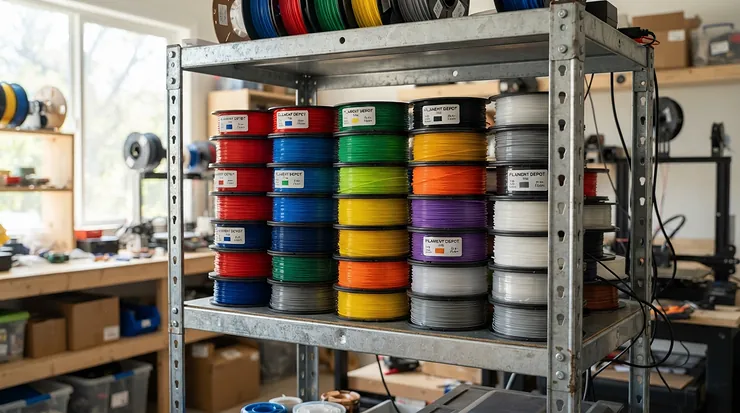
What is PLA filament 1kg? It is a standard 1 kg reel of polylactic acid thermoplastic, usually 1.75 mm in diameter, made for FDM 3D printers. PLA is plant-derived, prints at low temperatures (roughly 190-220°C) and rarely warps. That is why a 1 kg reel is the default buying unit for prototypes, models and household parts.
Walk into any British spare room, garage or school workshop with a 3D printer and you will almost certainly find a spool of it. Polylactic acid is the most widely used filament material in FDM printing, and for good reason: it is forgiving, cheap and smells faintly of warm sugar rather than hot regret.
But “easy” doesn’t mean “all spools are equal”. A bad reel is a quiet saboteur. It tangles at hour six of a twelve-hour print, swells to 1.80 mm in one spot and clogs your nozzle, or arrives so damp it sizzles like a frying pan. The difference between a £12 spool and a £25 one is rarely the plastic itself. It is the winding, the tolerance and the packaging.
That’s why this guide goes beyond a leaderboard. You’ll get seven real spools, honest analysis of what their specs mean in practice, and dedicated sections on tangle-free PLA filament spool design, spool winding quality, filament diameter consistency and moisture-sealed packaging. You’ll also find a full guide to PLA filament for Prusa printers.
A note on method: I haven’t printed on these spools myself, so everything below is spec-based analysis. Review commentary is aggregated from published roundups and retailer pages, and I flag where I couldn’t verify a meaningful pool of reviews. Prices are ranges, so check current pricing before buying.
Quick Comparison: The Best PLA Filament 1kg Spools at a Glance
| Spool | Standout | Typical price range | Best for |
|---|---|---|---|
| Prusament PLA | ±0.02 mm tolerance, QR batch data | Mid-£20s | Precision-minded and Prusa owners |
| Polymaker PolyLite PLA | Cardboard reel, jam-free guarantee | £15-£20 | All-round everyday printing |
| Polymaker PolyTerra PLA | Matte finish, eco-minded packaging | £12-£16 | Display pieces on a budget |
| Filamentive PLA | UK supplier, recycled content | £18-£25 | Sustainability-focused UK users |
| Overture PLA | Neatly wound, beginner-friendly | £12-£16 | First spools and tuning a new printer |
| Elegoo PLA | Wide colour range, low cost | £13-£18 | Budget colour variety |
| Hatchbox PLA | Long-standing Amazon workhorse | £17-£23 | Reliable fast delivery |
Read the table as a trade-off map, not a ranking. Prusament PLA buys you measurable precision, and Polymaker PolyTerra PLA and Overture PLA undercut it by roughly half. The middle of the range, Polymaker PolyLite PLA and Hatchbox PLA, is where most people sensibly land.
The real question is how much a ruined print costs you in time rather than plastic. If you print occasional trinkets, the cheaper end is fine. If you print fitted parts overnight, paying for tolerance and winding quality starts to look like insurance.
💬 Just one click — help others make better buying decisions too!😊
Top 7 PLA Filament 1kg Spools for UK Printers: Expert Analysis
1. Prusament PLA — tightest tolerances, per-spool QR data
Prusa Research makes this filament in-house, and the headline is its guaranteed ±0.02 mm diameter tolerance. Prusa describes that as beating the 0.05 mm industry standard.
Each 1.75 mm, 1 kg reel carries a QR code linking to that batch’s production data. In practice, a tighter tolerance means the extruder pushes a steadier volume of plastic per millimetre. That matters most on thin walls, small details and tuned flow settings. The QR code is genuinely unusual: if a spool misbehaves, you can check its recorded measurements instead of guessing.
Based on the spec comparison, this is the pick for anyone who tunes profiles carefully, owns a Prusa machine or prints parts that must fit together. Retailer listings stress consistent colour and good bed adhesion, and one 2026 roundup names it the best premium option for tolerances. I couldn’t verify a large pool of independent reviews for this exact listing, so treat the sentiment as indicative.
Availability on amazon.co.uk can vary, as Prusa has historically sold direct, so check stock first.
Pros:
- ✅ Guaranteed ±0.02 mm diameter tolerance
- ✅ QR code opens batch-specific quality data
- ✅ Consistent colour and good bed adhesion
Cons:
- ❌ Dearest spool in this round-up
- ❌ Amazon UK stock and colours can vary
Price: typically mid-£20s, so check current price. Verdict: worth it if precision matters to you, overkill if it doesn’t.
2. Polymaker PolyLite PLA — the sensible default, jam-free guarantee
One 2026 tested roundup crowns Polymaker PolyLite PLA best overall: consistent, a huge colour range and a fair price. It is the answer you’d get from most experienced printers, offered without drama.
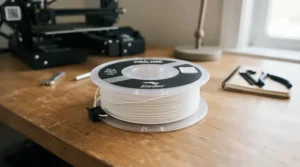
The standout spec isn’t a number but a format: a recyclable cardboard reel and a jam-free guarantee. A cardboard reel is lighter and easier to dispose of than plastic, and the guarantee tells you the maker expects clean winding. Practically, check that your spool holder’s roller width and spindle size suit a cardboard reel before ordering. Most do, but the odd narrow holder is fussy.
The honest take is that this is the spool for people who want to stop thinking about filament. It is quiet, predictable and widely stocked in 1.75 mm. Published roundups consistently place it in the “default recommendation” slot, though I couldn’t verify a large aggregated review sample for the specific Amazon listing.
Pros:
- ✅ Recyclable cardboard reel
- ✅ Jam-free guarantee from the maker
- ✅ Huge colour range at a fair price
Cons:
- ❌ Not the tightest published tolerance here
- ❌ Cardboard reels can suit some holders poorly
Price: around £15-£20, so check current price. Verdict: strong value, and the safest all-round pick.
3. Polymaker PolyTerra PLA — matte finish, eco-minded packaging
A UK-focused 2026 test ranked Polymaker PolyTerra PLA (Arctic Teal, 1.75 mm, 1 kg) its overall winner. It cited outstanding printability, eco-friendly packaging and a price around £12.50 at the time.
The matte finish is the practical draw. Layer lines read as soft texture rather than glossy ridges, which flatters models, planters and desk objects. The same test flagged limited colour vibrancy and unsuitability for high-strength parts as downsides. Standard PLA is brittle in thin sections, and a matte blend is not a structural filament.
My read: this is the spool for display and decorative work. If you print a bracket that gets knocked, you’d want something tougher than any standard PLA. Reviewer sentiment in that test was clearly positive on ease of use, and I couldn’t cross-check Amazon’s own review pool.
Pros:
- ✅ Matte finish hides layer lines well
- ✅ Eco-minded packaging
- ✅ Very competitive price per kilo
Cons:
- ❌ Colours less vibrant than glossy rivals
- ❌ Not suited to high-strength parts
Price: around £12-£16, so check current price. Verdict: outstanding value for decorative prints.
4. Filamentive PLA — UK-based supplier with recycled options
Filamentive PLA comes from a Bradford, West Yorkshire company that positions sustainability as its selling point. It offers recycled PLA, free recycling for PLA print waste and a spool-less ReFill format. Filamentive says that format cuts around 20% of plastic waste.
For UK buyers, a domestic supplier also means shorter shipping, no import surprises and easier support. The ReFill option is the interesting spec: you buy filament without the plastic reel, which saves material but means you need a reusable reel or adapter for your holder. Read the variant carefully before ordering.
Honestly assessed, this suits people who print a lot and care about waste. Recycled content can mean slightly less colour variety than virgin PLA. I couldn’t verify a large pool of independent reviews, and Amazon availability varies by variant, so check the listing.
Pros:
- ✅ UK supplier with free PLA waste recycling
- ✅ Spool-less ReFill option cuts packaging
- ✅ Recycled variants available
Cons:
- ❌ Pricier than budget imports
- ❌ ReFill needs a reusable reel
Price: around £18-£25 depending on variant, so check current price. Verdict: a sensible premium for sustainability-minded UK printers.
5. Overture PLA — neatly wound and beginner-friendly
One 2026 roundup names Overture PLA the pick for first spools, aimed at beginners and anyone tuning a new printer. Another lists it as best on a budget. Its Amazon title leans on “neatly wound”, which is the claim worth testing.
Why does winding matter more for beginners? A new printer needs calibration, and calibration only works if the filament behaves the same every time. A neatly layered reel feeds without sudden resistance, which means a failed test print is down to your settings, not your spool. That is exactly the isolation a beginner needs.
My view: this is the best “learn on it” spool. Published roundups lean positive on ease of use. I couldn’t verify a large aggregated Amazon review sample, so check recent reviews for winding complaints before buying.
Pros:
- ✅ Recommended for beginners and calibration
- ✅ Neat winding is a headline claim
- ✅ Low cost, so mistakes hurt less
Cons:
- ❌ Tolerance claims need checking on the listing
- ❌ Colour range smaller than some rivals
Price: around £12-£16, so check current price. Verdict: the sensible first spool.
6. Elegoo PLA — cheap, with a colour wall to match
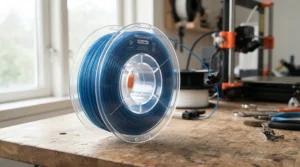
Elegoo PLA is the budget pick in one tested 2026 roundup, at roughly the equivalent of £13-£18 a kilo. It sits among the standard everyday PLAs, which that roundup says differ less in print quality than in where you buy them and how wide the colour range is.
That framing is useful. For plain PLA, you are largely paying for colour choice and availability, not magic chemistry. If you want six colours for a multi-part project, a wide range at a low price beats one premium spool.
The trade-off is quality control. Cheap does not mean bad, but check the listing for diameter claims and recent reviews mentioning winding or moisture. Roundups rate it well for value; I couldn’t verify a large Amazon review sample.
Pros:
- ✅ Strong budget price per kilo
- ✅ Wide colour choice
- ✅ Sensible for multi-colour projects
Cons:
- ❌ Packaging and winding vary by variant
- ❌ No batch data like premium rivals
Price: around £13-£18, so check current price. Verdict: good for colourful projects on a tight budget.
7. Hatchbox PLA — the Amazon workhorse
Hatchbox PLA is described in one 2026 roundup as the “Amazon workhorse”, best for next-day reliability. It is a long-standing, widely bought spool, and its appeal is availability rather than a standout spec.
In practice that matters more than it sounds. Running out of filament on a Sunday evening is a modern tragedy, and a spool you can order with fast delivery solves it. Delivery speed depends on Prime eligibility and stock, so check the listing rather than assuming.
The honest take: it is a dependable standard PLA, not a specialist. If you want a known quantity without researching smaller brands, it fits. I couldn’t verify a large aggregated review sample for the current listing, so scan recent reviews for batch consistency before you buy.
Pros:
- ✅ Widely stocked with quick delivery options
- ✅ Familiar, long-standing brand
- ✅ Good fit for repeat orders
Cons:
- ❌ Mid-pack price for a standard PLA
- ❌ No published batch-level data
Price: around £17-£23, so check current price. Verdict: a safe, convenient repeat-buy.
Spec Snapshot: Spool, Tolerance and Packaging
| Spool | Reel type | Diameter claim | Packaging note | Best for |
|---|---|---|---|---|
| Prusament PLA | Plastic reel | ±0.02 mm (verified) | QR batch data | Precision work |
| Polymaker PolyLite PLA | Cardboard | Check listing | Jam-free guarantee | Everyday printing |
| Polymaker PolyTerra PLA | Eco-minded reel | Check listing | Eco-minded packaging | Display prints |
| Filamentive PLA | Standard or ReFill | Check listing | Recycling scheme | Low-waste printing |
| Overture PLA | Check variant | Check listing | Neat-winding claim | Beginners |
| Elegoo PLA | Check variant | Check listing | Check listing | Colour variety |
| Hatchbox PLA | Check variant | Check listing | Check listing | Quick re-orders |
Only Prusament PLA has a guaranteed tolerance I could verify, and the table says so rather than guessing. That is itself useful information: if diameter claims matter to you, ask for the number and be sceptical when it is vague. Polymaker PolyLite PLA and Filamentive PLA compete on packaging and ethics rather than published precision.
Tangle-Free PLA Filament Spool: What Actually Prevents Jams
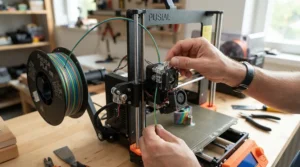
A tangle-free PLA filament spool is less a product feature than a result of three things: even winding, secured ends and a reel your holder actually suits. Tangles almost always begin when a loose loop slips under its neighbours. The next time the extruder pulls, that buried loop gets yanked tight and the print stalls.
What the maker controls
Winding tension is the big one. Too loose, and loops drop between layers. Too tight, and the filament stresses the reel. Makers like the one behind Polymaker PolyLite PLA market a jam-free guarantee, which signals confidence in their winding. Overture PLA leans on “neatly wound” as a headline claim.
What you control
Always clip the loose end into a reel hole the moment you stop printing. It takes two seconds and prevents the most common tangle by far. Mount the reel so it unwinds smoothly, without rubbing on a wall or holder edge.
Quick test
Before loading, pull a metre of filament slowly by hand. Even resistance is good, and sudden jerks suggest buried loops. A tangle-free PLA filament spool should unwind like a quiet conversation, not an argument.
Spool Winding Quality: How to Judge It Before You Print
Spool winding quality decides whether 330 metres of filament feeds smoothly or fights you. A 1 kg reel of 1.75 mm PLA holds roughly 330 m, so an average printing session pulls it through hundreds of tiny tugs.
The three-minute inspection
Look through the side of the reel when it arrives. Layers should sit flush, with no crossed loops poking up. Check that the loose end is clipped in. Then spin it gently and watch for wobble, which hints at a warped reel.
Why cardboard and plastic differ
Cardboard reels such as the one on Polymaker PolyLite PLA are lighter and recyclable, but a narrow holder can pinch them. Plastic reels like the Prusament PLA reel are stiffer. Neither is automatically better; compatibility with your setup is what counts.
What to do about poor winding
If a fresh reel looks messy, photograph it and contact the seller before printing. Sellers on Amazon generally handle returns for faulty goods, but check the policy. Spool winding quality is the cheapest defect to catch early and the most annoying to find at 3 a.m.
Filament Diameter Consistency: Why ±0.02 mm Matters
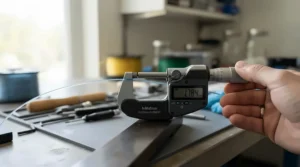
Filament diameter consistency is the quiet maths behind clean prints. Your slicer assumes 1.75 mm exactly. If the real filament is 1.80 mm, the cross-section area is about 5.8% bigger, so you over-extrude by that much. At 1.77 mm, the over-extrusion is only about 2.3%.
That is the case for Prusament PLA‘s ±0.02 mm guarantee. A tighter band means less flow variation across a long print, which shows up as steadier surfaces, cleaner thin walls and fewer dimension surprises. Prusa cites 0.05 mm as the industry norm, and the area maths shows why the gap is worth noticing.
Measure it yourself
A cheap digital calliper tells you plenty. Measure at several points along a metre of filament and rotate the calliper between readings, because filament can be slightly oval. If readings wander more than the maker claims, take note and report it.
How much does it matter?
For decorative prints, very little. For fitted parts, threaded inserts and snap-fits, a lot. Filament diameter consistency is the difference between a lid that clicks and a lid that argues.
Moisture-Sealed Packaging: What Good Looks Like
PLA absorbs moisture more slowly than nylon, but it still absorbs it. Prusa’s own guidance notes that even PLA can absorb enough moisture to cause printing problems, particularly in humid conditions or on printers that hold several spools for long jobs.
Signs of a damp spool
Listen for popping or crackling at the nozzle, and look for stringing, oozing and rough surfaces. A fresh, dry spool is quiet.
What good packaging includes
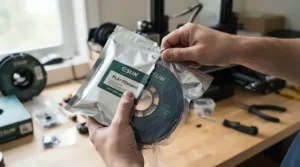
Look for a sealed bag, ideally vacuum-sealed, with desiccant inside. Check the seal on arrival and photograph it if the bag is open or the desiccant is sodden. Moisture-sealed packaging only helps if it is intact.
Storage and drying
Once opened, return the reel to a resealable bag or airtight box with fresh desiccant. A dry box slows new moisture uptake but does not dry a wet spool. For that, use a dedicated filament dryer at a low temperature, well below PLA’s softening point of roughly 60°C, following the maker’s guide.
PLA Filament for Prusa Printers: A Compatibility Guide
PLA filament for Prusa printers is straightforward: Prusa’s current machines, including the MK4S, MINI+, Core One and XL, take 1.75 mm filament. So any standard 1.75 mm, 1 kg reel physically fits.
Profiles and settings
PrusaSlicer ships a Prusament PLA profile at roughly 215°C nozzle and 60°C bed. For third-party spools, a generic PLA profile is the sensible starting point, followed by a temperature tower to fine-tune. Retailer guidance for Prusament PLA suggests a heated bed around 50-60°C on a smooth PEI, textured or satin sheet, and says drying is generally not required for fresh spools.
Reel and holder compatibility
Check reel width and hole size against your spool holder, especially with cardboard reels like Polymaker PolyLite PLA. The spool-less ReFill option from Filamentive PLA needs a reusable reel.
The XL caveat
Prusa notes the multi-tool XL is more susceptible to moisture because filament sits loaded for long periods, and recommends drying beforehand. If you own an XL, treat moisture-sealed packaging as a priority.
How to Choose PLA Filament 1kg: 6 Steps
- Confirm the diameter. Most consumer printers, including Prusa’s, use 1.75 mm. A 2.85 mm spool simply won’t feed, so check your printer manual first.
- Decide what you’re printing. Decorative pieces suit matte options like Polymaker PolyTerra PLA. Fitted parts reward the tolerance of Prusament PLA.
- Check the tolerance claim. Look for a stated number, such as ±0.02 mm. Vague wording like “high precision” tells you nothing.
- Inspect the packaging. Prefer vacuum-sealed bags with desiccant. A loose bag is a warning sign.
- Check reel and holder fit. Cardboard reels, plastic reels and spool-less refills all need different holders.
- Set a budget per kilo, then pad for mistakes. Budget options such as Overture PLA and Elegoo PLA make learning cheap, while premium spools make results predictable.
Common Mistakes When Buying PLA Filament 1kg
The first mistake is buying purely on price. A £10 spool that jams twice costs you more in failed prints than a £16 spool that doesn’t. The second is ignoring reel format. A beautiful cardboard reel that won’t sit on your holder is an expensive paperweight.
Third, people skip the arrival check. Open the bag, inspect the winding and check the seal before you load anything, because returns are much easier before the spool is half used. Fourth, many buyers assume “PLA+” or “silk” means stronger or better. Those labels describe blends and finishes, and quality varies, so read specifics rather than adjectives.
Finally, there is the storage mistake. Leaving an opened reel on the printer for months in a damp room is how good filament goes bad. A resealable bag and desiccant cost pennies compared with the spool.
PLA Filament 1kg vs Alternatives: Which Format Wins?
| Option | Main advantage | Main drawback | Best for |
|---|---|---|---|
| PLA 1 kg reel (e.g. Hatchbox PLA) | Easy, widely stocked | Plastic or cardboard reel waste | Most home users |
| PETG 1 kg reel | Tougher, more heat-tolerant | Stringier, fussier to tune | Functional parts |
| Multi-kilo bulk reels | Lower cost per kilo | Heavy, can foul some holders | High-volume printers |
| Spool-less refill (e.g. Filamentive PLA) | Less packaging waste | Needs a reusable reel | Low-waste printers |
The standard 1 kg PLA reel wins on simplicity, because everything is built around it. PETG is the upgrade when parts need toughness, and bulk reels suit people who burn through plastic weekly. If sustainability matters, Filamentive’s UK guide explains how its spool-less format reduces plastic waste, though you’ll need to budget for a reusable reel.
For most people, a 1 kg reel hits the sweet spot: enough plastic for dozens of prints, light enough to store and cheap enough to experiment with.
Long-Term Cost: What a PLA Filament 1kg Spool Really Costs Per Print
A 1 kg reel feels like a big spend until you do the arithmetic. A typical 30 g decorative print uses 3% of a spool. At £15 a kilo that is about 45p of plastic, and at £25 a kilo about 75p. The price gap between budget and premium spools is pennies per small print.
Where money really goes
Failures. A single failed 200 g print on a £14 spool wastes roughly £2.80 of plastic, plus hours of machine time. If a more precise, better-wound spool prevents even one failure in ten prints, the premium can pay for itself.
Cost-per-use view
For casual printers, budget options like Elegoo PLA and Overture PLA give the lowest cost per successful print. For batch production or fitted parts, Prusament PLA and Polymaker PolyLite PLA reduce the risk of expensive failures. Total cost of ownership also includes storage: a resealable bag and desiccant add a few pounds but protect the whole spool.
Practical Usage Guide: Your First 30 Days With a New Spool
Day one: unbox and inspect
Check the seal, photograph any damage and inspect the winding through the reel side. Clip the loose end in before you do anything else.
Week one: calibrate
Load the spool and print a temperature tower and a small calibration cube. For Prusament PLA, start from Prusa’s profile. For others, start from a generic PLA profile at about 200-215°C and adjust by 5°C steps.
Weeks two to four: maintain
Return the spool to a resealable bag with desiccant whenever you stop for more than a day. Re-clip the end every time. If you hear popping or see stringing, dry the spool at a low temperature rather than blaming your slicer.
Common first-month mistakes
Printing too hot, which causes stringing. Printing with a dirty bed, which kills adhesion. And leaving the reel loose on the shelf. Fix those three and most “bad filament” problems disappear.
Real-World Scenarios: Matching PLA Filament 1kg to Your Setup
The weekend hobbyist (budget under £15 a spool)
You print figures and planters a few times a month in a spare room. Polymaker PolyTerra PLA gives you a matte finish at a very low price, and Overture PLA keeps early mistakes cheap.
The Prusa owner tuning fitted parts
You print brackets, enclosures and snap-fit lids on a MK4S. Prusament PLA matches the machine, offers verifiable ±0.02 mm tolerance and provides batch data if something goes wrong.
The student with a shared flat and limited space
Storage and delivery matter more than anything. Hatchbox PLA is easy to reorder, and Polymaker PolyLite PLA offers a recyclable cardboard reel. Keep spools in sealed bags to stay damp-proof in a cold, humid flat.
The low-waste maker
You print weekly and hate throwing things away. Filamentive PLA with ReFill, plus its recycling scheme for PLA waste, suits your habits, provided you’ve bought a reusable reel.
Safety and Regulations: Printing PLA Filament 1kg Indoors in the UK
PLA is generally regarded as the lower-emission option among common filaments, but “lower” isn’t “none”. The UK’s Health and Safety Executive tested desktop printers in its research report RR1146 and found they emit many ultrafine particles and some vapours. It also found that an enclosing hood with filtered ventilation cut particle emissions by 97%.
Practical steps
Print in a ventilated room, not a bedroom you sleep in. Consider an enclosure and keep the printer away from where you sit for long periods. Let the print area clear before opening an enclosure.
Food and toys
PLA prints are not automatically food-safe. Layer lines trap residues, and colourants and additives vary, so check supplier statements. If you sell printed toys, UK toy safety rules apply, so check the official government guidance before selling.
FAQ
❓ How long does a PLA filament 1kg spool last?
❓ Can I use any PLA filament for Prusa printers?
❓ Is a cheap PLA filament 1kg spool worth buying?
❓ Can I recycle leftover PLA filament in the UK?
❓ Should I buy a spool-less refill instead of a standard reel?
Conclusion
Buying PLA filament 1kg is easy to get wrong precisely because it looks so simple. Underneath the colour swatches, the real differences are winding, diameter control and packaging. Those decide whether a spool disappears quietly into good prints or turns into a midnight troubleshooting session.
If you want measurable precision and own a Prusa, Prusament PLA is the clear premium choice. If you want the sensible default, Polymaker PolyLite PLA is hard to fault, and Polymaker PolyTerra PLA is the best value for decorative work. Filamentive PLA suits UK buyers who care about waste. Overture PLA is the safest first spool, Elegoo PLA is the budget colour option and Hatchbox PLA is the dependable repeat-buy.
Whichever you choose, inspect the winding, check the seal and store the spool dry. Those three habits matter as much as the brand on the label.
Recommended for You
- PLA Vs PETG Vs ABS: 7 Best Filaments & Mistakes To Avoid (2026)
- 1.75mm Filament Multipack: 7 Best Bundles For UK Makers (2026)
- 3D Printer Filament Under £15 per Kg: 7 Best UK Buys (2026)
Disclaimer: This article contains affiliate links. As an Amazon Associate, I earn from qualifying purchases. If you purchase products through these links, we may earn a small commission at no additional cost to you.
✨ Found this helpful? Share it with your friends! 💬🤗
