
In This Article
Somewhere between the mystery spool that costs less than a takeaway coffee and the boutique reel priced like a decent bottle of Rioja sits a very happy middle ground. In 2026, 3D printer filament under £15 per kg is that middle ground. It’s cheap enough that a failed print is a shrug rather than a sulk, and good enough that you aren’t gambling every Saturday afternoon on whether the spool will behave.
Here’s how this guide works, so you know what you’re getting. It’s built from published specifications, UK deal-tracker data and the aggregated sentiment of real buyer reviews. It is not a bench test, and I make no claim to have printed with every spool. Where something couldn’t be verified, I say so rather than papering over it. That honesty matters more than usual here, because budget 3D printer filament is a category where the sticker price swings wildly from week to week.
You’ll find seven real spools, from the plain and reliable to the fast and fancy. You’ll also find plain-English explainers on price per kilogram, 1.75mm diameter tolerance and vacuum-sealed spools. If you own an Ender 3, there’s a dedicated section on filament for Ender 3 machines. If you’re brand new, the 30-day plan covers filament for beginners step by step.
What Is 3D Printer Filament Under £15 per kg?
3D printer filament under £15 per kg is standard 1.75mm thermoplastic feedstock, usually PLA or PLA+, that costs less than £15 for every kilogram of spool. It feeds fused filament fabrication printers such as the Ender 3, and the best examples pair a tight diameter tolerance with sealed packaging that keeps moisture out.
Why £15? UK hobbyist forum threads show the same 1kg of PLA ranging from roughly £10 to well over £20. So £15 is a sensible ceiling: it excludes the overpriced, includes the genuinely good, and leaves room for the odd promotion. Amazon prices move daily, so treat every range below as a snapshot and check the current price before buying.
Quick Comparison: 7 Best 3D Printer Filament Under £15 per kg at a Glance
Before the deep dive, here’s the whole field on one screen. Price ranges reflect what I could find at the time of research; “check listing” means I couldn’t verify the detail.
| Product | Material | Diameter tolerance | Vacuum-sealed? | Typical price range | Best For |
|---|---|---|---|---|---|
| Elegoo PLA | PLA | ±0.02mm | Yes (per maker) | Around £8–£12 | First-time buyers |
| Sunlu PLA+ | PLA+ | ±0.02mm | Yes (per maker) | Low-to-mid £10s | Tough functional parts |
| Eryone PLA Plus | PLA+ | ±0.03mm | Yes (per listing) | Around £12 on promotion | Colourful decorative prints |
| Geeetech PLA | PLA | ±0.03mm (GIANTARM listing) | Check listing | Around £9–£10 | Test prints and tuning |
| Jayo PLA | PLA | Check listing | Check listing | Check per-kg figure | Bulk printing |
| Creality Ender-PLA | PLA | ±0.03mm | Not confirmed | From around £9 upwards | Stock Ender 3 owners |
| Creality Hyper PLA | High-speed PLA | ±0.03mm | Not confirmed | Low £20s usually | Fast modern printers |
Looking at the comparison above, Elegoo PLA pairs the tightest published tolerance with one of the lowest outlays, which is why it leads for newcomers. Sunlu PLA+ is the one to choose when toughness matters more than pennies. Pure thrift hunters will find Geeetech PLA hard to beat on sticker price. Creality Hyper PLA sits outside the budget for most of the year and only earns its place on fast printers.
💬 Just one click — help others make better buying decisions too!😊
Top 7 3D Printer Filament Under £15 per kg: Expert Analysis
Every entry below follows the same logic: what the spec means in practice, who should buy it, what reviewers actually say, and where the weak spots hide. Spools are ordered roughly from safest all-rounder to most specialist.
1. Elegoo PLA — best all-round value for first-timers
The Elegoo PLA earns its place by being quietly competent at everything a newcomer cares about, without charging a premium for it. Its listing quotes ±0.02mm accuracy on 1.75mm filament. In practice, the thread entering your extruder should stay between roughly 1.73mm and 1.77mm, steady enough that flow stays predictable and under-extrusion is less likely. The maker also says each spool is dried for around 24 hours before being vacuum-sealed with desiccant, and that it winds onto a cardboard spool rather than plastic.
Based on the spec comparison, the cardboard spool is the one thing to check. It’s greener, but make sure it sits happily on your spool holder. The quoted 190–230°C nozzle range is generous, which is exactly what you want in filament for beginners who haven’t dialled in a profile yet. It also suits filament for Ender 3 owners who simply want a spool that behaves on default settings.
Reviewers consistently praise the neat winding and value. A June 2026 UK deal thread drew comments that the price was average rather than special, with one commenter noting it had been cheaper elsewhere. A small minority of buyers report occasional feeding hiccups.
Pros:
- ✅ Tight ±0.02mm diameter tolerance quoted
- ✅ Dried and vacuum-sealed with desiccant, per the maker
- ✅ Wide 190–230°C window forgives beginner settings
Cons:
- ❌ Cardboard spool may not suit every holder
- ❌ Occasional feeding complaints in reviews
Expect around £8–£12 at the time of research; check current price. Verdict: the safest all-round value pick on this list.

2. Sunlu PLA+ — toughest budget pick for functional parts
Where plain PLA snaps, Sunlu PLA+ is built to give a little. The maker claims impact strength of up to 8 kJ/m², two to three times that of ordinary PLA. Treat that as a manufacturer figure, but the practical meaning is clear: clips, brackets and phone stands that survive being dropped rather than shattering.
The listing quotes ±0.02mm tolerance, 330 metres of filament per kilogram and vacuum packing with a desiccant pack. The “PLA+” label isn’t a standardised material, so recipes differ between brands. Community discussion warns that some cheap makers simply relabel basic PLA as PLA+, but published figures at least give you something to hold the seller to. On the PLA+ 2.0 variant, the maker suggests 205–220°C and speeds up to 300mm/s, which suits faster printers.
Reviewers frequently highlight consistent diameter and clean feeding straight from the sealed bag. One buyer did report tension problems near the end of a 1kg spool, so inspect the winding before loading.
Pros:
- ✅ Toughened formula suits functional prints
- ✅ ±0.02mm tolerance and sealed packaging quoted
- ✅ Neat winding praised by reviewers
Cons:
- ❌ PLA+ recipes vary between brands
- ❌ UK pricing fluctuates between listings
Reported in the low-to-mid-£10s range on promotion; prices may vary, so check the listing. Verdict: the pick if your prints need to survive real life.
3. Eryone PLA Plus — widest colour and finish range
If your shelf looks dull, Eryone PLA Plus is the cheerful antidote. The maker’s range stretches well beyond black and white into silk, matte, rainbow and colour-shift finishes. The PLA Plus listing quotes ±0.03mm tolerance, so diameter can wander between about 1.72mm and 1.78mm. That’s a touch looser than the ±0.02mm rivals and translates to a worst-case flow swing of roughly 7% versus about 5%. For decorative prints that’s rarely visible, but tight-fitting functional parts would feel it.
It ships vacuum-packed, and the maker’s other lines recommend around 190–220°C. An Amazon deal-tracking page reported roughly 4.4 out of 5 across more than 9,000 reviews at the time of research, a hefty sample. Reviewers praise strong colours and layer adhesion. A few flag quality-control wobbles: one buyer measured dips to about 1.71mm on a different line from the same maker, and another found a spool arrived damp.
Here’s the commercial wrinkle. The same page showed the spool dropping to around £12 from a much higher usual price, so this is a promotion-dependent pick. Always check the price per kilogram at checkout.
Pros:
- ✅ Huge colour and finish variety
- ✅ Large review pool, rated around 4.4/5
- ✅ Vacuum-packed with good layer adhesion reported
Cons:
- ❌ ±0.03mm tolerance looser than the tightest rivals
- ❌ Usual price may exceed £15 outside promotions
Verdict: best for decorative work, provided you buy at the right moment.
4. Geeetech PLA — cheapest sticker price, no frills
Sometimes the unglamorous option is the right one, and Geeetech PLA is about as unglamorous and thrifty as this category gets. UK marketplace sellers have listed a 1kg spool at around £9–£10, and a UK forum poster comparing prices found the maker’s own site quoting roughly £10 for 1kg. The maker also sells under the GIANTARM name on Amazon, where the silk-finish listing quotes ±0.03mm tolerance and vacuum packaging.
What does that mean in practice? ±0.03mm is perfectly serviceable for proof prints, calibration cubes and anything where cosmetics beat precision. Based on the spec comparison, it’s the spool to buy when you’re tuning a new printer and expect to bin the first twenty prints. Why burn premium plastic on test towers?
Sentiment is broadly positive but thin on recent UK detail. A forum member who had used the brand called it okay, and the GIANTARM listing in the US showed roughly 4.3 out of 5 from more than 12,000 ratings in early 2026. Some enthusiasts suggest it shares manufacturing with other budget brands, but that’s unverified, so don’t buy on that assumption.
Pros:
- ✅ Among the cheapest spools on this list
- ✅ Vacuum packaging quoted on the Amazon-brand listing
- ✅ Ideal for test prints and tuning
Cons:
- ❌ ±0.03mm tolerance, not the tightest
- ❌ Little recent UK-specific review data
Around £9–£10 at the time of research; prices may vary. Verdict: the thrift pick for prototypes.
5. Jayo PLA — bonus 100g on every spool
The cheeky trick of Jayo PLA is arithmetic. Spools are sold at 1.1kg rather than 1kg, so each reel hides an extra 100 grams. Think in price per kilogram and it matters: a spool priced at £14 (purely for illustration) delivers material at about £12.70 per kg, which is how a nominally pricier listing can undercut a 1kg rival. Deal-community posts widely describe the brand as a sub-brand of the maker behind Sunlu PLA+, citing matching spools and tags, though I couldn’t find that confirmed by the maker.
Here’s the honest limitation. I couldn’t verify a stable UK listing price, nor a published tolerance or packaging spec I’d stand behind. Check those on the listing before buying. If it shows ±0.02mm and vacuum packing, it’s a strong bulk option; if not, treat it as a gamble.
Sentiment is mixed. Several forum users call it solid PLA, and one says they’ve printed dozens of fidget toys without trouble. Another buyer, on a manufacturer review page, found it brittle compared with their usual spool. That split is typical of budget filament, and it’s why a single trial spool beats a ten-kilo order.
Pros:
- ✅ 1.1kg spools give extra material per reel
- ✅ Multipacks can lower the per-kilo cost
- ✅ Users report reliability for toys and decor
Cons:
- ❌ UK price and specification vary by listing
- ❌ Some buyers report brittleness
Calculate the cost per kilogram from the listing, not the headline. Verdict: best for high-volume printers who do the sums.

6. Creality Ender-PLA — brand-matched for Ender 3 owners
Some buyers simply want the filament that shares a logo with their printer, and the Creality Ender-PLA is aimed squarely at them. Published figures line up neatly with a stock machine: ±0.03mm diameter tolerance, a suggested 190–230°C nozzle range, and a recommended print speed of 40–80mm/s with the part-cooling fan at full whack.
Those numbers tell a story. A 40–80mm/s suggestion is realistic for an original-style Ender 3, so you won’t be fighting unrealistic expectations, though it’s less suited to modern high-speed machines. The listing also shows tensile strength around 34MPa and RoHS and REACH certification, handy reassurance for school and craft use. I couldn’t confirm vacuum sealing in the specifications I found, so check the listing.
Sentiment splits sharply. One reviewer on the maker’s store calls it their go-to spool. Another found it stringy on an Ender 3, and a newcomer warned that pushing temperatures to the maximum caused clogs. The lesson: start in the middle of the range, not at the top.
Pros:
- ✅ Published speeds match stock Ender 3 hardware
- ✅ RoHS and REACH certification listed
- ✅ Brand designed around Ender 3 printers
Cons:
- ❌ Reviews split on stringing
- ❌ Vacuum sealing not confirmed
Around £9 on one third-party UK marketplace listing, with official stores charging more; prices may vary. Verdict: safe, familiar and fine if you tune temperature sensibly.
7. Creality Hyper PLA — fast-printing stretch pick
Think of Creality Hyper PLA as the sports-car option that occasionally wanders into budget territory. Its headline is speed. The maker says the high-flow, fast-cooling formula supports print speeds up to 600mm/s, backed by two-way laser diameter measurement and a ±0.03mm tolerance. Manufacturer claims also put its tensile strength above ABS and its toughness above traditional PLA. Treat those as marketing until you’ve verified them on your own parts.
What does 600mm/s mean for you? Only a printer with the acceleration, extruder and hotend to match can use it. A stock Ender 3 can’t, so you’d be paying for speed you can’t deliver. On a modern fast machine, flow-optimised filament can be the difference between crisp corners and blobs.
The catch is price. A specialist UK retailer listed it in the low £20s with a modest discount, and a UK forum poster put it at about £21 on Amazon. That’s well over our £15 line, so this is the stretch pick, relevant only when a promotion or multipack pulls the per-kilogram cost down. I couldn’t verify a robust pool of UK reviews for this specific listing, so read recent feedback before buying.
Pros:
- ✅ Rated by the maker for up to 600mm/s
- ✅ Laser-measured diameter control claimed
- ✅ Wide colour range available
Cons:
- ❌ Usually well above £15 per kilogram
- ❌ Speed benefits need capable hardware
Verdict: skip it unless it dips under budget and your printer is genuinely fast.
Specs Head to Head
| Product | Diameter tolerance | Published nozzle range | Notable detail | Best For |
|---|---|---|---|---|
| Elegoo PLA | ±0.02mm | 190–230°C | Cardboard spool, dried 24h (per maker) | First spool |
| Sunlu PLA+ | ±0.02mm | Around 200–230°C, varies by line | 330m per kg, toughened | Functional parts |
| Eryone PLA Plus | ±0.03mm | Around 190–220°C, varies by line | Large colour range | Decorative prints |
| Geeetech PLA | ±0.03mm (GIANTARM listing) | See spool label | Plain, low-cost PLA | Proof prints |
| Jayo PLA | Check listing | See spool label | 1.1kg spools | Bulk volume |
| Creality Ender-PLA | ±0.03mm | 190–230°C | 40–80mm/s suggested | Stock Ender 3 |
| Creality Hyper PLA | ±0.03mm | See spool label | Up to 600mm/s claimed | Fast printers |
The pattern is clear: the ±0.02mm spools (Elegoo PLA and Sunlu PLA+) give the most consistent flow, while the ±0.03mm group is fine for casual use. The only real outlier is speed. Creality Hyper PLA is designed for a different class of printer than Creality Ender-PLA, so buying the “better” one for the wrong machine is wasted money.
Filament for Beginners: Your First 30 Days
If you’re new, treat the first month like learning to drive: dull, deliberate and far cheaper than a crash. This plan turns filament for beginners into a routine.
Days 1–3: unbox and calibrate. Check the vacuum seal is intact, load the spool and print a simple calibration cube. Start in the middle of the maker’s temperature range, around 200–210°C for most PLA, not the top. A bed at 50–60°C is plenty. Use your cheapest spool here, with Geeetech PLA a natural fit, because you’re tuning, not showing off.
Days 4–10: tame the stringing. Stringing is the classic first complaint. Lower the nozzle temperature in 5°C steps and adjust retraction before blaming the filament.
Days 11–20: graduate to a keeper. Move to Elegoo PLA for everyday prints or Sunlu PLA+ for parts that need to survive being dropped.
Days 21–30: build a storage habit. After each print, put the spool back in a zip bag or box with desiccant. Don’t leave it hanging on the printer in a damp room.
Common mistakes in the first month:
- Running the nozzle at maximum temperature “for strength”, which invites clogs
- Ignoring a worn PTFE tube or tired hotend
- Buying ten kilos before testing one spool
- Printing too fast before the first layer is reliable
Do this and a £10-ish spool becomes a classroom rather than a gamble.
Real-World Scenarios: Which Spool for Which Maker?
Specs are abstract; lives aren’t. Here are three illustrative profiles, with budget, environment and frequency of use spelled out.
The student with a second-hand Ender 3. Prints twice a week in a chilly rented room, with a tight monthly filament budget. The sensible move is Elegoo PLA for reliability, with leftover filament sealed in a lidded box. Damp rooms punish open spools, so this person gets more from a storage box than from a pricier spool.
The parent running school projects. Prints weekly, wants bright colours and ideally reassurance about materials. Eryone PLA Plus delivers variety, and Creality Ender-PLA lists RoHS and REACH certification. One caution: don’t assume any PLA is food-safe or toy-safe. Check what the maker actually declares, and supervise young children around small printed parts.
The hobby engineer printing brackets. Prints several times a week on a quicker printer, in a garage that swings between cold and damp. Sunlu PLA+ suits the toughness requirement, and Creality Hyper PLA earns a look only when a promotion drags the per-kilo cost under £15. Garage humidity makes sealed storage non-negotiable.
✨ Ready to Fill Your Spool Rack?
🔍 Take your first prints further with these carefully chosen spools. Click any highlighted product name to check current pricing and availability. Prices may vary, so compare the price per kilogram before you buy. Here’s to smooth first layers and fewer tangled spaghetti monsters!
How to Choose 3D Printer Filament Under £15 per kg
Choose by true cost per kilogram, tight diameter tolerance, dry packaging and a speed rating that matches your printer. Work through these seven steps:
- Calculate price per kilogram from the actual spool weight, not the headline number. A 1.1kg spool or multipack changes the sum.
- Read the diameter tolerance. ±0.02mm gives steadier flow than ±0.03mm, though both are workable for hobby use.
- Look for vacuum-sealed spools with desiccant. If the listing doesn’t mention packaging, treat that as a question, not a yes.
- Match the filament to your printer’s speed. A stock Ender 3 is happy at modest speeds, while fast machines want high-flow formulas.
- Decide between PLA and PLA+. PLA, a polyester made from renewable plant sources, is easy and forgiving. PLA+ adds toughness but isn’t a defined material, so the recipe is the maker’s secret.
- Check the spool itself: cardboard or plastic, hub-hole size, and whether reviewers mention tangles near the end.
- Skim the newest reviews first. Batch quality drifts over time, and last year’s five stars may not describe this year’s spool.
Here’s what most buyers overlook: steps 1 and 7 do more work than all the others combined. A spec sheet describes the factory’s intentions, whereas recent reviews describe what actually landed on doormats.
Price per Kilogram: The Real Cost of Cheap Filament
The real price per kilogram is the listing price divided by the weight you actually receive, adjusted for prints that fail.
Start with the maths. A 1kg spool of 1.75mm PLA holds roughly 330 metres, according to one maker. At around £12 per kg, a gram costs just over a penny, so a 50g print costs about 60p. Now add reality. If one print in ten ends up in the bin, the effective cost of usable plastic rises by around 11%, taking that £12 spool to roughly £13.30 per usable kilogram. Cheap filament that fails often isn’t cheap.
Bonus weight matters too. A 1.1kg spool like Jayo PLA divides the price over 10% more plastic, and multipacks can shave more off, but always do the division yourself.
What about premium? Enthusiast threads suggest well-regarded premium brands sit around £25–£35 per kilogram. Print 50g a week and you’ll use about 2.6kg a year, so premium costs roughly £35–£60 more annually than a £12 spool. For casual hobbyists that’s real money for marginal gains. For anyone printing client work or overnight jobs, one saved failure can repay it. The honest answer is that budget wins until your time becomes more expensive than your plastic.
1.75mm Diameter Tolerance: What ±0.02mm Really Means
1.75mm diameter tolerance is the permitted wobble either side of the nominal thickness. ±0.02mm means the filament should measure between 1.73mm and 1.77mm, while ±0.03mm allows 1.72mm to 1.78mm.
Why should you care about hundredths of a millimetre? Your extruder pushes filament forward by length, but the amount of plastic delivered depends on cross-sectional area, which scales with the square of the diameter. At the extremes, ±0.02mm gives a flow swing of about 5%, while ±0.03mm gives about 7%. That’s invisible on a decorative vase and noticeable on a snap-fit enclosure.
The caveat is that tolerance figures are maker claims, not guarantees. Reviewers occasionally measure their own spools. One found dips to about 1.71mm on a spool rated ±0.03mm, and another reported thick sections jamming in a push-fit connector. Neither is typical, but both are a reminder to verify.
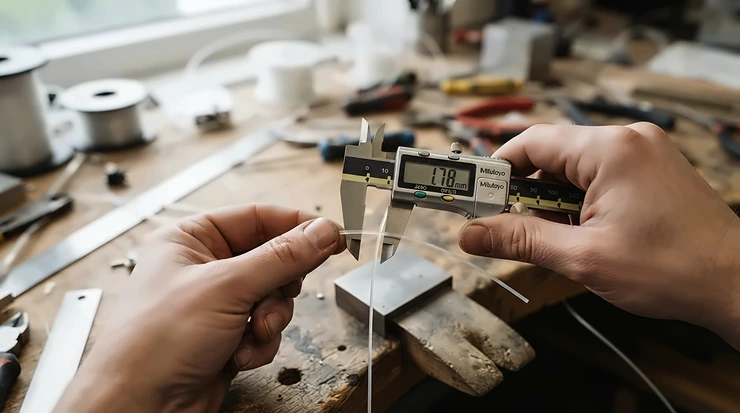
A practical tip: run digital callipers along the first metre or so of a new spool and note the readings. If values stray outside the stated range, contact the seller. It takes two minutes and could save a week of mysterious under-extrusion. Among our seven, Elegoo PLA and Sunlu PLA+ publish the tightest figures, while Creality Ender-PLA and Creality Hyper PLA sit at ±0.03mm.

Vacuum-Sealed Spools: Marketing or Genuine Protection?
Vacuum-sealed spools genuinely help, because many filament plastics absorb moisture from the air. Wikipedia’s overview of 3D printing filament notes that many thermoplastics are hygroscopic and that extruding damp plastic causes dimensional flaws. Translated: a wet spool can bubble, string and print rough.
The listings back this up in practice. The Elegoo PLA and Sunlu PLA+ pages both describe roughly 24 hours of drying before sealing with desiccant. Eryone PLA Plus describes a vacuum bag with a desiccant pack. For Creality Ender-PLA and Creality Hyper PLA, I couldn’t confirm sealed packaging, so check before assuming.
Sealing isn’t a guarantee, though. One reviewer reported a spool arriving full of moisture and needing eight hours in a dryer. Warning signs include crackling or popping at the nozzle, tiny bubbles, wispy strings and a rough surface. Britain’s famously damp climate doesn’t help, so vacuum-sealed spools are best seen as a head start, not a force field.
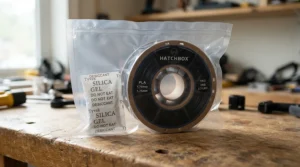
Once opened, the habit matters more than the factory bag. A zip bag or lidded box with fresh desiccant after each print covers most hobbyists. The Sunlu PLA+ listing even recommends re-bagging the spool after use. Reuse the original vacuum bag where you can: it’s already the right size.
Filament for Ender 3: What Actually Works
For an Ender 3, pick 1.75mm PLA or PLA+ with a ±0.03mm tolerance or better, a wide temperature window and a speed rating that matches your machine.
The Ender 3 family is huge, covering the original, V2, Neo and newer V3-series models, so the best spool depends on which you own. Stock-style machines are happiest with forgiving, mid-speed filament. The Creality Ender-PLA suggests 40–80mm/s, which suits them well, and Elegoo PLA pairs a generous temperature window with tight tolerance. Newer machines marketed on speed can exploit high-flow options such as Creality Hyper PLA or speed-rated Sunlu PLA+ 2.0.
Three practical tips for filament for Ender 3 owners:
- Start at 200–210°C and move in 5°C steps. One newcomer’s review warned that maxing out the temperature caused clogs.
- Inspect the hotend and PTFE tube. A reviewer with a five-year-old machine described repeatedly replacing tubing after clogs, a reminder that tired hardware mimics bad filament.
- Measure your spool holder. A Sunlu PLA+ 1kg spool is listed at 195mm across and 57mm wide, and cardboard spools like Elegoo PLA behave differently from plastic ones.
Get these three right and almost any spool on this list will print acceptably on an Ender 3.
Budget Filament vs Premium Alternatives
Is paying more ever sensible? Here’s how the tiers compare.
| Option | Typical price per kg | Consistency | Best For |
|---|---|---|---|
| Budget PLA, such as Elegoo PLA and Geeetech PLA | Under £15 | Good; ±0.02–0.03mm quoted | Learning and test prints |
| Budget PLA+, such as Sunlu PLA+ | Low-to-mid £10s | Good; toughened | Functional parts |
| Fast PLA, such as Creality Hyper PLA | Low £20s usually | Optimised for high speed | Quick printers |
| Premium enthusiast brands | Roughly £25–£35 (forum reports) | Reportedly tightest quality control | Production and display pieces |
The table shows that the jump from budget to premium buys consistency and support, not magic. For a hobbyist, Elegoo PLA and Sunlu PLA+ cover nearly every scenario, and Creality Hyper PLA only justifies itself on hardware that can use the speed. If you ever print for paying customers, premium starts to make sense; otherwise it’s a luxury.
Whichever tier you choose, know your rights. Which? explains that when you buy online you can cancel from the moment you order until 14 days after delivery, with a further 14 days to send goods back. Faulty or not-as-described items are covered under the Consumer Rights Act as they would be in a shop. So if a damp or mis-wound spool arrives, you have recourse, and it’s worth keeping the packaging until you’ve test-printed.
FAQ
❓ Is PLA+ worth paying extra for over standard PLA?
❓ Do I need a filament dryer if my spools are vacuum-sealed?
❓ How long does a 1kg spool of 1.75mm filament last?
❓ Is cheap PLA safe for food or children's toys?
❓ Are multipacks cheaper per kilogram than single spools?
Conclusion
Let’s land the plane. 3D printer filament under £15 per kg is no longer a compromise category, provided you shop on the right criteria: true price per kilogram, honest diameter tolerance and packaging that keeps moisture out.
For most people, Elegoo PLA is the safest starting point, with its tight tolerance, wide temperature window and sealed packaging. Sunlu PLA+ is the upgrade when parts need to survive real life. Eryone PLA Plus wins on colour, Geeetech PLA wins on pure thrift, and Jayo PLA rewards anyone willing to do the per-kilo arithmetic. Creality Ender-PLA is the familiar match for stock Ender 3 owners, while Creality Hyper PLA is a stretch pick for fast machines and promotions only.
Remember the caveats I flagged throughout: UK prices move daily, a few specs couldn’t be verified, and review sentiment is mixed on every budget brand. Buy one spool, test it, then scale up. Your first layers, and your wallet, will thank you.
Recommended for You
- PCL Filament Refills For 3D Pens: 7 Safest Picks UK (2026)
- 3D Pen Filament Refills: 7 Best Picks For UK Makers (2026)
- 3D Pen For Artists: 7 Brilliant Picks For UK Makers (2026)
Disclaimer: This article contains affiliate links. As an Amazon Associate, I earn from qualifying purchases. If you purchase products through these links, we may earn a small commission at no additional cost to you.
✨ Found this helpful? Share it with your friends! 💬🤗
