
In This Article
Picture a 28mm knight who has just lost his face to a smear of layer lines. It happens to everyone, and the culprit is rarely your printer. More often it’s the spool. The right PLA filament for miniatures is the difference between a figure that looks cast and one that looks as though an overenthusiastic glue gun squeezed it out.
There’s a reason PLA filament for miniatures keeps winning this argument. Polylactic acid is a plant-derived thermoplastic that prints at modest temperatures, barely warps and holds crisp edges. That’s exactly what you want when a sword is thinner than a matchstick. Published roundups of FDM tabletop printing keep landing on PLA and PLA+ as the dependable choices. But “PLA” is a very big tent. Glossy or matte? Basic or PLA+? Grey, black or white PLA filament for painting? And what does a 0.2mm layer height actually do to a face the size of a lentil?
This guide answers all of that with honest analysis built on published specs and review sentiment, not invented test sessions. You’ll get seven genuine spools you can find through amazon.co.uk. You’ll also get a straight-talking look at resin vs filament detail, a primer and acrylic paint routine that tames layer lines, and a section on PLA filament for cosplay props for when your ambitions outgrow a 32mm base.
One housekeeping note: every price below is a range, not a quote. Prices move constantly, so check current price on the listing before you buy.
Quick Comparison: The Best PLA Filament for Miniatures at a Glance
Short on time? This table sorts the seven picks by character and budget. Prices are indicative per 1kg spool at the time of research and vary by colour and multipack.
| Product | Character | Indicative price (1kg) | Best For |
|---|---|---|---|
| SUNLU PLA+ 2.0 | Tough, smooth PLA+ | Around £12-£20 | All-round heroes and troops |
| ELEGOO PLA | Basic smooth PLA | Around £10-£15 | Bulk armies on a budget |
| Overture Matte PLA | Matte finish | Around £13-£20 | Painters who hate layer lines |
| Polymaker PolyTerra PLA | Matte finish | Around £14-£22 | Soft, paint-ready surfaces |
| eSUN PLA+ | PLA+ (HS variant noted for fine work) | Around £12-£18 | Small-nozzle fine detail |
| Polymaker PolyLite CosPLA | Sand-friendly cosplay PLA | From around £20 | Large figures and props |
| Polymaker PolyMax PLA | Impact-resistant PLA | Around £20-£30 | Thin, handled, snap-prone parts |
Read the table sideways and a pattern emerges. Spending more buys toughness and finish, not magical detail. ELEGOO PLA and SUNLU PLA+ 2.0 share the same ±0.02mm headline tolerance, so the real difference lies in how they cope with thin parts. If layer lines are your nemesis, the two matte options, Overture Matte PLA and Polymaker PolyTerra PLA, are the shortcut. Neither replaces proper primer and acrylic paint, though.
💬 Just one click — help others make better buying decisions too!😊
Top 7 PLA Filament for Miniatures: Expert Analysis
Every pick below is a real spool with real specs. Review sentiment is aggregated from published roundups and retailer feedback, because star ratings on amazon.co.uk change daily and I can’t verify them for you. Treat the live listing as the final word. Think of what follows as reasoning from the spec sheet, not a claim of bench testing.
1. SUNLU PLA+ 2.0 — best all-rounder for tabletop figures
Think of SUNLU PLA+ 2.0 as the Swiss Army knife of the shelf: tough enough for sword arms, smooth enough for faces. Its upgraded formulation is pitched at resisting the brittleness and cracking that plague standard PLA, which matters when a spear is thinner than a pencil lead.
The ±0.02mm diameter tolerance means steadier flow, so walls stay even and cheekbones stay blob-free. The listed nozzle window of roughly 205-220°C is comfortably cool, which helps limit stringing between legs and weapons. A 50-60°C bed keeps bases stuck down without drama. A 1kg spool of 1.75mm holds around 330 metres, which is a lot of rank-and-file.
Based on the spec comparison, this is the spool to hand someone printing their first army. It’s forgiving, easy to find in grey (handy for reading shadow detail) and sold in white too. At 0.2mm layer height it behaves well for troops, and you can drop lower for characters. One 2026 roundup crowns the grey version its overall pick for flow consistency.
Retailer feedback and roundups praise overall print quality and colour range. I couldn’t verify individual amazon.co.uk review counts, so check the live listing.
Pros:
- ✅ Consistent ±0.02mm diameter for even walls
- ✅ Tougher thin parts than basic PLA
- ✅ Wide colour range, including grey and white
Cons:
- ❌ Smooth finish shows layer lines more than matte
- ❌ Moisture-sensitive, so dry storage is essential
Around £12-£20 per spool. Excellent value for a near-premium spec.
2. ELEGOO PLA — budget champion for bulk armies
When you need forty identical cultists by Saturday, ELEGOO PLA is the sensible answer. Its pitch is simple: dependable consistency at the lowest price in this guide.
A European retailer lists it at ±0.02mm tolerance, with a nozzle ceiling of 230°C and a 65°C bed. In practice that means the usual PLA recipe works and spare spools won’t bankrupt you. At around 330 metres per kilo, a single spool covers a surprising number of squads.
Here’s the honest analysis. Basic PLA is stiffer and more brittle than PLA+, so it suits troops that live on a shelf or a gaming mat, not dragons with wafer-thin wings. For rank-and-file printed at 0.2mm layer height and finished with filler primer, the difference between this and a premium spool is mostly invisible by the time paint goes on. Its smooth finish does reveal ridges under light, so plan to prime.
Roundups name it the best budget pick for bulk armies. A retailer listing I found showed ratings around 4.5 out of 5 on that retailer’s own site, which is not the same as amazon.co.uk reviews, so verify there.
Pros:
- ✅ Lowest price tier with ±0.02mm tolerance
- ✅ Easy to print on stock settings
- ✅ Ideal for large batches of troops
Cons:
- ❌ Brittler on thin weapons and wings
- ❌ Smooth finish reveals layer lines
Around £10-£15 per spool. Unbeatable cost per figure.
3. Overture Matte PLA — the layer-line-hiding painter’s pick
The headline feature of Overture Matte PLA is optical. Matte particles diffuse light across the surface, softening the banded look that gives FDM prints away.
It’s made to a ±0.02mm tolerance using camera-monitored diameter control, so flow stays steady. One 2026 roundup calls it the best choice for painting and likens the effect to a built-in primer coat. That’s generous, so I’d call it a head start rather than a replacement. Matte surfaces generally give primer and acrylic paint a little more grip than glossy plastic, which means fewer base-coat headaches.
Who is it for? Anyone whose figures get painted rather than just primed grey and shelved. On curved armour, shadows hide ridges that gloss would highlight. Grey or tan colours hide lines even better than bright ones, and I’d lean on them for fine detail work.
Community and roundup commentary is consistently positive on the finish. Individual amazon.co.uk reviews weren’t something I could verify, so check star ratings and recent comments on the listing.
Pros:
- ✅ Hides layer lines better than glossy PLA
- ✅ ±0.02mm tolerance for even extrusion
- ✅ Grips primer and paint nicely
Cons:
- ❌ Still needs filler primer for a smooth finish
- ❌ Matte finish can soften the tiniest edges
Around £13-£20 per spool. Strong value if painting is your goal.
4. Polymaker PolyTerra PLA — matte finish with brand-name polish
Polymaker PolyTerra PLA is the matte spool that designers keep recommending. One prop-and-model creator prints almost everything in matte PLA because the parts assemble tighter.
Its published nozzle window of roughly 190-230°C is generous, and a roundup lists a ±0.03mm tolerance, slightly looser than the ±0.02mm claimed by budget rivals. That’s a good reminder that tolerance numbers are marketing as much as engineering. Slicer presets exist for popular printers, so setup is closer to “choose profile, press print.”
A word on naming. The same formula is now sold as Polymaker PolyTerra PLA‘s successor line, Panchroma Matte PLA, so listings use either name. Colours like Fossil Grey make a sensible undercoat for figures. Matte plus a grey base is a quiet cheat code for painters.
Community feedback calls the matte texture genuine, says it hides layer lines and notes that it photographs cleanly. A forum thread about 0.2mm-nozzle miniatures singled PolyTerra out as a TL;DR pick. As ever, check amazon.co.uk reviews directly.
Pros:
- ✅ True matte finish hides layer lines
- ✅ Printer presets for popular machines
- ✅ Muted colours suit painted figures
Cons:
- ❌ Listings switch between PolyTerra and Panchroma names
- ❌ Costs more than budget spools
Around £14-£22 per spool. Fair value for the finish.
5. eSUN PLA+ — the fine-detail small-nozzle favourite
The reputation of eSUN PLA+ rests on consistent flow. One 2026 roundup calls the HS variant a secret weapon for 0.2mm nozzle printing.
A 0.2mm nozzle lays down very thin lines, so any ooze or flow wobble shows up instantly on small faces. On paper, filament that melts predictably means cleaner eyebrows and crisper rims. The brand also publishes printer-specific parameters, which shortens the tuning phase.
Variants are the catch. The basic eSUN PLA+-family listings I found on amazon.co.uk mirrors showed a looser ±0.05mm tolerance for plain PLA, so check exactly which version you’re buying before relying on a “fine detail” reputation. For standard 0.4mm printing it’s a perfectly good everyday PLA+, and the reasoning is the same as for SUNLU PLA+ 2.0.
Roundup commentary leans positive, especially on small-nozzle work. A retailer listing showed a perfect score for the grey version, though I couldn’t see how many reviews sat behind it, so I wouldn’t read much into it.
Pros:
- ✅ Noted for fine detail with small nozzles
- ✅ Printer-specific parameters published
- ✅ Good everyday PLA+ for general use
Cons:
- ❌ Variant confusion between PLA, PLA+ and HS
- ❌ Basic PLA listing shows a looser ±0.05mm
Around £12-£18 per spool. Good value if you pick the right variant.
6. Polymaker PolyLite CosPLA — sand-friendly spool for large figures and props
Sanding is the whole point of Polymaker PolyLite CosPLA. It was developed for cosplay makers and tuned for easy sanding, durability and paint adhesion, which also suits 75mm busts and display pieces.
It comes in two flavours: Version A for easiest sanding and Version B for maximum toughness. The maker advises printing slower than standard PLA, with a top volumetric speed of 15mm³/s, and raising nozzle temperature to 220-230°C if you push that flow. A bed of 25-60°C works and no enclosure is needed. Translation: it’s easy, but don’t treat it like speed-PLA.
Don’t expect extra heat resistance. The maker itself says heat-resistant formulas compromise ease of printing, so CosPLA stays standard PLA in a hot car. For 28mm troops it’s overkill, but for anything you’ll sand, fill and glue, it’s a time-saver.
Buyers on the maker’s own store describe easy sanding and good durability, and one reports that props with five or more walls survive drops. Those are store reviews, not amazon.co.uk ones, and availability on Amazon UK varies, so check before planning around it.
Pros:
- ✅ Sands more easily than standard PLA
- ✅ Two versions: easy sanding or extra toughness
- ✅ Good paint adhesion for finished props
Cons:
- ❌ Pricier than everyday PLA
- ❌ No extra heat resistance
From around £20 per spool. Worth it for sanded, painted showpieces.
7. Polymaker PolyMax PLA — tough thin parts that bend before they break
If your figures get moved by enthusiastic eight-year-olds, Polymaker PolyMax PLA is the insurance policy. A 2026 roundup describes it as highly impact-resistant, the sort of PLA that bends before it snaps.
That matters on dragon wings, outstretched fingers and hand-held weapons, the exact spots where basic PLA cracks. It’s the most expensive tier in this guide, so match it to the parts that genuinely get handled. For static display figures it’s like buying a helmet for a statue.
The sensible way to use it is selectively. Print gaming-table heroes and thin accessories in PolyMax, and troops in ELEGOO PLA or SUNLU PLA+ 2.0. For cosplay prop pieces that take knocks at conventions, its toughness is a genuine asset, though it still shares PLA’s low heat tolerance.
Roundup reviewers praise durability. I couldn’t verify amazon.co.uk review volumes, so read recent comments on the listing.
Pros:
- ✅ Impact-resistant for thin, handled parts
- ✅ Suits rough gaming-table use
- ✅ Well-known brand with published print profiles
Cons:
- ❌ Highest price tier in this guide
- ❌ Overkill for static display figures
Around £20-£30 per spool. Premium, so use it where toughness matters.
Side-by-Side Spec Snapshot
| Product | Stated tolerance | Character | Best For |
|---|---|---|---|
| SUNLU PLA+ 2.0 | ±0.02mm | Tough, smooth | First armies |
| ELEGOO PLA | ±0.02mm | Basic, smooth | Rank-and-file bulk |
| Overture Matte PLA | ±0.02mm | Matte | Painters |
| Polymaker PolyTerra PLA | ±0.03mm (roundup) | Matte | Paint-ready surfaces |
| eSUN PLA+ | Check listing | PLA+ | 0.2mm nozzle users |
| Polymaker PolyLite CosPLA | Check data sheet | Sand-friendly | Large props |
| Polymaker PolyMax PLA | Check listing | Impact-resistant | Handled parts |
Tolerance figures cluster tightly at ±0.02-0.03mm, so treat them as a tie-breaker, not a headline. ELEGOO PLA, SUNLU PLA+ 2.0 and Overture Matte PLA are indistinguishable on paper, which means finish and toughness should decide it. Where I’ve written “check listing”, the figure wasn’t verifiable at the time of research.
✨ Ready to Start Printing?
🔍 Take your tabletop armies to the next level with these carefully selected spools. Click on any highlighted product name to check current pricing and availability on amazon.co.uk, then get ready to paint some seriously good-looking figures!
What Is PLA Filament for Miniatures?
PLA filament for miniatures is a polylactic acid thermoplastic, usually 1.75mm and often a PLA+ or matte blend, chosen for FDM printers because it prints cleanly at low temperatures, holds fine edges, warps very little and takes primer and paint well. It suits tabletop figures, terrain and cosplay prop parts where cost and ease matter.
Why does it dominate? Compared with PETG or ABS, PLA gives the sharpest detail of the common FDM materials and the fewest headaches. The trade-off is heat. PLA’s glass transition sits around 60-65°C, so a figure left on a sunny car dashboard can slump. Most guides therefore pair PLA with indoor display and PETG or ASA for anything exposed to heat.
Think of PLA as the reliable family hatchback of 3D printing: not glamorous, but it starts every morning. Once you accept that, the real choices narrow to finish (matte or smooth), toughness (basic or PLA+) and colour. The rest of this guide helps you make those calls.
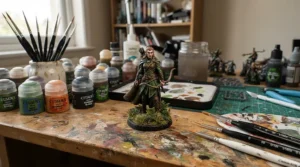
How to Choose PLA Filament for Miniatures
Follow these seven steps and you’ll avoid most regrets.
- Confirm the diameter. Most desktop printers want 1.75mm. Look for a stated tolerance of around ±0.02-0.03mm, since consistent diameter means consistent walls.
- Pick a finish. Matte hides layer lines; smooth shows more detail crispness under light. Painters should lean matte.
- Choose basic or PLA+. Basic suits shelf-bound troops. PLA+ suits thin, handled parts that would otherwise snap.
- Choose colour for the job. Grey and dark tones hide lines and show shadow. White PLA filament for painting is possible but fussier (see below).
- Match the nozzle. A 0.4mm nozzle is forgiving. A 0.2mm nozzle rewards low-ooze, consistent-flow spools.
- Check packaging and storage. Sealed bag, desiccant and a spool your printer accepts all save headaches in a damp British garage.
- Buy one spool first. Test it before you commit to a multipack.
If you’re still torn between resin and PLA, the resin vs filament detail section below explains when each wins.
0.2mm Layer Height for Miniatures: When It’s Fine and When It Isn’t
Here’s the uncomfortable truth: 0.2mm layer height is the standard “everyday” setting on many slicers, and it’s coarse for faces. A 30mm-tall figure prints in roughly 150 layers at 0.2mm. Drop to 0.1mm and that doubles to around 300, with print time rising accordingly.
So when is 0.2mm layer height acceptable? Rank-and-file troops, terrain and bases, especially under filler primer. Many designers cap their parts at 0.2mm for exactly that reason. For heroes, faces and anything the eye lands on, guides generally suggest roughly 0.08-0.12mm.
A practical routine
- Print a single test bust at 0.2mm layer height and again at 0.12mm.
- Slow outer walls and top layers. Guides suggest roughly 20-40mm/s for small PLA figures.
- Orient faces so the key detail isn’t on a stair-stepped slope.
- Keep filament dry. Damp spools smear fine detail faster than any layer height.
Don’t confuse layer height with nozzle size. A 0.2mm nozzle is a different tool entirely, one users pair with layers well under 0.2mm. Even then, one hobbyist reports that a 0.2mm nozzle at 0.06mm layers still falls short of resin and prints fail more often.
Resin vs Filament Detail: An Honest Comparison
The resin vs filament detail debate has a clear loser on pure sharpness, and it isn’t resin. FDM is limited by nozzle size and layer height. The detail limits of FDM mean features under roughly 0.5mm tend to soften or vanish, while resin handles miniatures and jewellery far better.
| Factor | Resin | PLA filament |
|---|---|---|
| Typical XY detail | Around 35-50µm | Nozzle-limited (0.4mm, or 0.2mm for fine work) |
| Layer height | Around 10-50µm | Around 100-200µm |
| Surface | Smooth, near-invisible layers | Visible layer lines |
| Durability | More brittle | Tougher, forgiving |
| Cost and mess | Higher, with washing and curing | Lower and simpler |
| Best For | Display heroes and faces | Terrain, bulk armies and beginners |
Resin wins decisively on detail, but filament wins on cost, toughness and simplicity. If your priority is a hero model with crisp eyes, resin is the honest answer. If you want fifty troops, a dungeon and a few cosplay pieces, ELEGOO PLA and a good primer will serve you better. Many hobbyists run both, and that’s a perfectly reasonable endgame.
White PLA Filament for Painting: Smart Shortcut or Trap?
White looks like the obvious choice. It’s already the colour of a primer coat, so surely it saves a step? In practice, white PLA filament for painting is the fussiest colour. Light colours reveal layer lines far more readily than dark ones, and the ridges that vanish in grey stand out in white.
That doesn’t make white useless. Bright yellows, pale skin tones and clean pastels need fewer coats over a pale base. The recommended workflow is to start with grey filler primer, sand it smooth, then switch to a white primer and finish with your white colour coat. So white PLA filament for painting works best when you still do the grey-then-white sequence.
Which spools come in white? SUNLU PLA+ 2.0 and the SUNLU PLA+ family are sold in white, and several other brands in this guide offer it too, but confirm the colour variant on each listing. If you’re new to this, I’d start with grey or a dark matte and graduate to white once your primer and acrylic paint routine is dialled in.
Thin white sections can also appear slightly translucent under light, so test a small piece first. For white PLA filament for painting on large props, add an extra primer pass.
Primer and Acrylic Paint on PLA: A Step-by-Step Finishing Guide
Paint hides nothing. As Formlabs’ guide to priming and painting 3D prints puts it, primer is essential if you want a show-stopping result, and FDM parts with larger layer heights may need sanding first. Here’s the routine.
- Clean up. Trim supports and sand nubs. Wet sanding keeps PLA cool, since friction can soften it.
- Choose your primer. Filler primer fills the valleys between layers; plain primer only improves adhesion. For tiny faces, apply thin coats, because filler can bury detail.
- Prime in thin passes. Several light coats beat one heavy coat. Let it cure fully.
- Sand and re-prime. A fine wet-sand after priming makes the surface feel injection-moulded.
- Base coat. Use thin acrylic layers. Paint tends to collect in any layer lines you didn’t fully smooth.
- Detail. Hobby acrylics from the usual suspects work well. Washes and drybrushing add depth.
- Seal. A matt varnish protects the finish from handling.
Matte spools like Overture Matte PLA and Polymaker PolyTerra PLA shorten steps three and four, but they don’t skip them. Spray primer outdoors or in good ventilation, and keep primer and acrylic paint away from small children and pets.

PLA Filament for Cosplay Props: What Changes?
PLA filament for cosplay props follows the same logic as miniatures, scaled up and with extra baggage. Bigger parts mean longer prints, more gluing and a lot more sanding.
PLA is easy to print, takes filler and primer well and is light enough to wear all day. The big problem is heat. PLA softens at roughly 55-65°C, so a helmet left in a hot car can warp, and PETG (about 75°C) is the safer choice for hot days outdoors. Even a British heatwave can punish a boot full of props.
The finishing workflow is familiar:
- Print armour at around 0.16mm and detail pieces finer.
- Sand from about 120 to 400 grit, ideally wet.
- Join parts with two-part epoxy.
- Fill, prime and paint.
For big pieces, 0.2mm layer height is often fine because filler primer and heavy sanding will hide the ridges. Polymaker PolyLite CosPLA is built for this, and Polymaker PolyMax PLA suits the parts that take knocks. Wear a respirator and glasses when sanding, and ventilate when priming. For PLA filament for cosplay props, a matte spool plus filler primer and acrylic paint gives the best value.
Problem → Solution Guide: Fixing Common PLA Miniature Print Problems
Problem: webbing and strings between limbs. Lower the nozzle temperature within the filament’s range and dry the spool. Cooler settings are why spools like SUNLU PLA+ 2.0 (roughly 205-220°C) are forgiving.
Problem: fuzzy faces and soft detail. Slow outer walls to around 20-40mm/s and drop the layer height from 0.2mm to nearer 0.1mm on faces. A small nozzle with a flow-consistent spool such as eSUN PLA+ helps too.
Problem: snapped swords and wings. Switch thin parts to PLA+ or Polymaker PolyMax PLA, and thicken fragile features slightly in your slicer.
Problem: layer lines showing through paint. Move to a matte spool, prime in thin coats, and sand between passes. Gloss exaggerates ridges, and primer and acrylic paint can’t hide what you haven’t smoothed.
Problem: white prints look blotchy. Use the grey-then-white primer sequence from the white PLA filament for painting section.
Long-Term Cost and Storage: What PLA Filament for Miniatures Really Costs
Here’s the good news: filament is the cheapest part of the hobby. As a rough planning figure, a 28mm infantry figure with a modest base often uses around 6-12g. At those weights, the cost per figure is pocket change.
| Tier | Example | Indicative £/kg | Approx. cost of a 10g figure | Best For |
|---|---|---|---|---|
| Budget | ELEGOO PLA | £10-£15 | 10p-15p | Bulk armies |
| Mid | SUNLU PLA+ 2.0, Overture Matte PLA, eSUN PLA+ | £12-£20 | 12p-20p | General painting |
| Premium | Polymaker PolyLite CosPLA, Polymaker PolyMax PLA | £20-£30 | 20p-30p | Props and tough parts |
Even premium filament costs only pennies more per figure, so choose by finish and toughness, not by saving 10p. Your real costs are failed prints, primer and paint. The best way to protect your investment is storage. Humidity ruins fine detail long before a spool runs out, and a damp British garage is basically a sponge. A sealed box with desiccant is cheap insurance, and PLA+ in particular benefits from it.
Safety and Ventilation: Using PLA Filament for Miniatures Responsibly
PLA is generally considered the lower-emission option among common filaments, but “lower” isn’t “none”. HSE research report RR1146 tested desktop FDM printers with PLA and ABS, and guidance built on that research favours enclosures and ventilation, plus PLA wherever possible. Reported results suggest an enclosing hood cut particle emissions to the room dramatically. Guidance based on the work also suggests waiting some minutes before opening an enclosure after a print.
Practical steps: don’t park the printer beside your pillow, ventilate the room, and keep it enclosed if you can. When sanding, wear a respirator and glasses, and spray primer outdoors or with good airflow. This isn’t medical or legal advice, so check manufacturer guidance and current HSE material for your own set-up.
FAQ: PLA Filament for Miniatures
❓ Which is the best budget PLA filament for miniatures in the UK?
❓ How many miniatures can I print from a 1kg spool?
❓ What varnish should I use on painted PLA miniatures?
❓ Do I need a dry box for PLA filament for miniatures?
❓ Is PETG better than PLA for gaming miniatures?
Conclusion: Choosing Your PLA Filament for Miniatures
The best PLA filament for miniatures isn’t the most expensive one. It’s the one that matches how you paint and play. SUNLU PLA+ 2.0 is the safest all-rounder, ELEGOO PLA wins on cost for big armies, and Overture Matte PLA and Polymaker PolyTerra PLA are the matte shortcuts for painters. eSUN PLA+ rewards small-nozzle detail work, Polymaker PolyLite CosPLA suits sanded props and large figures, and Polymaker PolyMax PLA protects the parts that get handled.
Remember the bigger picture. A 0.2mm layer height is fine for troops and terrain but coarse for faces. Resin vs filament detail favours resin for heroes and filament for everything else. White PLA filament for painting needs the grey-then-white primer routine. A good primer and acrylic paint workflow will do more for your results than any spool upgrade. And for PLA filament for cosplay props, plan for heat, sanding and a respirator.
Start with one spool, print a test bust and refine from there. Your future army will thank you.
✨ Ready to Print Sharper Figures?
🔍 Pick the spool that fits your painting style, click any highlighted product name to check current pricing and availability on amazon.co.uk, and turn that pile of plastic into an army worth showing off!
Recommended for You
- PLA Filament 5kg Bulk Buy: 7 Best Proven Picks (2026)
- PLA Filament 1kg: 7 Best Spools For UK Printers (2026)
- PLA Vs PETG Vs ABS: 7 Best Filaments & Mistakes To Avoid (2026)
Disclaimer: This article contains affiliate links. As an Amazon Associate, I earn from qualifying purchases. If you purchase products through these links, we may earn a small commission at no additional cost to you.
✨ Found this helpful? Share it with your friends! 💬🤗
