In This Article
There’s a very specific kind of heartbreak that comes with pulling a print off the plate and realising your model is 40mm too tall for your vat. You cut it into three pieces, print each one separately, and spend the next weekend playing amateur surgeon with superglue and filler primer, trying to hide the seams. If that sounds painfully familiar, a large-format resin 3D printer is the fix you’ve been putting off buying.
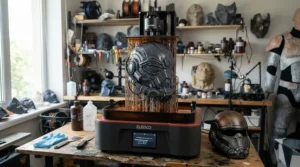
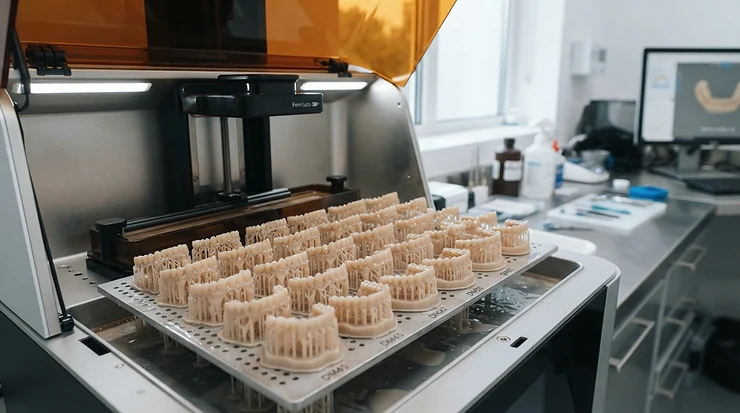
In 2026, “large format” in the resin world generally means a build volume that clears 250mm in at least one dimension, and the machines on this list stretch that definition properly — some fit a full adult helmet in a single piece, others swallow eighty miniatures on one plate without breaking a sweat. Whether you’re after a big build volume resin printer for full-scale busts, a large resin printer for props and cosplay armour, or a genuine resin printer for batch printing runs of small parts, there’s a machine below built for exactly that job.
We’ve pulled together seven real, currently available printers spanning budget, mid-range and professional territory, based on published specifications and aggregated review sentiment from UK and international sources. Every price you see below is a range rather than an exact figure, because Amazon pricing shifts by the week — always check the current price before buying. Let’s get into it.
What Is a Large-Format Resin 3D Printer?
A large-format resin 3D printer is an MSLA/DLP machine built around stereolithography (vat photopolymerisation), the process in which light cures liquid resin into a solid shape layer by layer, with a build volume large enough to print full-scale props, busts or dozens of miniatures in one uninterrupted job — typically 250mm or more on at least one axis.
Quick Comparison Table
| Printer | Build Volume | Resolution | Price Range | Best For |
|---|---|---|---|---|
| Elegoo Jupiter SE | 277.8 x 156.3 x 300mm | 6K, 51µm | around £450-£550 | Budget large-format entry |
| Anycubic Photon M3 Max | 298 x 164 x 300mm | 7K, 46µm | £600-£700 range | Cheapest big build volume resin printer |
| Anycubic Photon Mono M7 Max | 298 x 164 x 300mm | 12K, ~24µm | £650-£780 range | All-round large-format flagship |
| Elegoo Jupiter 2 | 302.4 x 162 x 300mm | 16K, 20×26µm | £700-£800 range | Best resolution-to-size ratio |
| UniFormation GK3 Ultra | 300 x 160 x 300mm | 16K, 20×26µm | £1,050-£1,200 range | Premium detail at scale |
| Phrozen Sonic Mega 8K S | 330 x 185 x 300mm | 8K, 43µm | £950-£1,250 range | Resin printer for batch printing |
| Peopoly Phenom Forge | 288 x 162 x 350mm | 6K, UL-certified | £1,600-£1,800 range | Professional production use |
Looking at the spread above, the gap between entry-level and professional large-format machines isn’t really about build volume — most of these seven sit within a few centimetres of each other on X and Y. It’s the screen resolution, the automation (auto-levelling, resin feeding, heated vats), and the build quality that justify the jump from Elegoo Jupiter SE territory to Peopoly Phenom Forge money. If your projects are mostly cosplay props and full-size busts, prioritise Z-height and heated vats; if you’re chasing painted-miniature detail at scale, put resolution first.
💬 Found a printer that fits your projects? One click helps others make better buying decisions too!😊
Top 7 Large-Format Resin 3D Printers: Expert Analysis
1. Elegoo Jupiter SE — best budget entry into large-format printing
The Elegoo Jupiter SE proves you don’t need to spend four figures to stop splitting prints into pieces. Its 277.8 x 156.3 x 300mm build volume, driven by a 12.8-inch 6K monochrome LCD at 51-micron XY resolution, gives you genuine large-format headroom without a large-format price tag.
In practice, that 51-micron pixel size means fine facial detail on miniatures will look softer than on the 16K machines further down this list, but for busts, terrain, cosplay accessories and anything printed at 100mm-plus, the difference is barely noticeable. Based on the spec comparison, this is the printer for someone who wants to try large-format printing before committing serious money to it — first-time buyers and hobbyists upgrading from a standard-size resin printer are the obvious audience. Reviewers consistently report that setup is close to plug-and-play, with the auto resin feeder and USB air purifier simply sliding into place, and a pre-loaded test print included on the bundled USB stick.
Pros:
- ✅ Large 6K screen delivers sharp detail at a low price
- ✅ Built-in auto resin feeding system reduces manual top-ups
- ✅ Integrated air purifier noticeably cuts resin odour
Cons:
- ❌ 51-micron XY resolution trails newer 16K rivals
- ❌ No Wi-Fi, so USB is your only file-transfer route
At around £450-£550, the Elegoo Jupiter SE is the best-value doorway into large-format resin printing on this list, and a sensible first purchase for anyone unsure whether they’ll actually use the extra build volume.

2. Anycubic Photon M3 Max — cheapest route to a genuinely huge build volume
If the standout feature you care about is sheer litres, the Anycubic Photon M3 Max is worth a hard look. It packs a 298 x 164 x 300mm build volume — 14.7 litres of usable space — behind a 13.6-inch 7K monochrome screen, and it’s now one of the most affordable ways to hit that volume class.
The 46-micron XY resolution won’t win detail contests against 16K screens, but on prints over 80-100mm — full helmets, statues, architectural models — that resolution gap becomes almost invisible to the naked eye. What most buyers overlook about this model is that its laser-etched build platform and dual guide rails were genuinely advanced for a mid-range machine when launched, and they still hold up: adhesion issues that plague cheaper large-vat printers are rare here. Reviewers note the auto resin filling system works reliably with standard-viscosity resins, though thicker specialist resins can be hit-or-miss with the feed mechanism.
Pros:
- ✅ Among the cheapest routes into a 14-litre build volume
- ✅ Laser-etched plate improves adhesion and easy part removal
- ✅ Auto resin filling keeps long overnight prints topped up
Cons:
- ❌ Manual 4-point levelling feels dated next to auto-level rivals
- ❌ 7K screen resolution trails the 12K/16K newcomers on this list
At a price range of £600-£700, this is the model to pick if your priority is maximum big build volume resin printer capacity per pound spent, and you can live without the latest screen tech.
3. Anycubic Photon Mono M7 Max — the all-round large-format flagship
The Anycubic Photon Mono M7 Max is the machine most reviewers reach for when they want one printer to cover cosplay props, terrain, and detailed miniatures without owning three separate machines. Its 298 x 164 x 300mm build volume comes wrapped in a 12K monochrome screen with roughly 24-micron XY resolution, paired with Anycubic’s COB LighTurbo 3.0 light engine.
Here’s what the spec sheet won’t tell you outright: that light source matters more than the resolution number. LighTurbo 3.0 combines a chip-on-board LED array with a Fresnel lens calibrated to keep light within a 3-degree angle and over 90% uniformity, which is why edge-of-plate prints on this machine come out consistently cured rather than under-exposed like on cheaper large-vat rivals. Dynamic vat heating is the other quiet win here — it keeps resin viscosity stable even in an unheated garage in a British winter, which genuinely improves print success rates. Reviewers consistently flag the resin pump as slightly inconsistent unit-to-unit, and the bundled Photon Workshop slicer as behind Lychee or ChituBox in polish, but the mechanical build and print quality draw near-universal praise.
Pros:
- ✅ Huge 14.7-litre build volume rivals full-size FDM machines
- ✅ COB LighTurbo 3.0 gives genuinely even edge-to-edge exposure
- ✅ Dynamic heating keeps resin viscosity consistent in cold rooms
Cons:
- ❌ Resin pump reliability varies between individual units
- ❌ Photon Workshop slicer lags behind rival slicing software
Priced in the £650-£780 range, the Anycubic Photon Mono M7 Max is the safest all-round pick on this list if you want one large-format resin printer for props, minis and everything in between.
4. Elegoo Jupiter 2 — the best resolution-to-size ratio available
The Elegoo Jupiter 2 is what happens when a manufacturer refuses to trade build volume for detail. Its 302.4 x 161.98 x 300mm build area is paired with a 14-inch 16K monochrome LCD delivering 20 x 26-micron XY resolution — genuinely sharp enough to resolve individual strands of hair or fine chainmail texture at a scale most large-format machines simply blur.
On paper this means you’re getting flagship-tier resolution in a chassis built for batch runs and big single models, which is a combination that used to force a choice. Based on the spec comparison with the smaller original Jupiter, Elegoo also added a heated vat, auto resin refill and reclaim, and a genuinely useful ten-second FEP film swap — small conveniences that add up across a busy print schedule. Reviewers who’ve run both generations note the improved consistency edge-to-edge, though the camera placement for remote print monitoring draws consistent criticism, and the bundled SatelLite slicer runs noticeably slower than third-party alternatives like ChituBox.
Pros:
- ✅ 16K screen resolves fine facial and textile detail at scale
- ✅ Heated vat plus auto refill and reclaim cuts hands-on time
- ✅ Ten-second FEP swap is a genuine time-saver mid-project
Cons:
- ❌ Camera placement makes remote monitoring less useful than it should be
- ❌ Bundled SatelLite slicer runs slower than ChituBox alternatives
At around £700-£800, the Elegoo Jupiter 2 currently offers the best resolution-per-pound of any large-format resin printer on this list, and it’s a strong pick for miniature painters who’ve outgrown a standard-size vat.
5. UniFormation GK3 Ultra — premium detail with industrial-grade build quality
The UniFormation GK3 Ultra earned its reputation as the first large-format printer to ship with a genuine 16K screen, and that hasn’t changed: a 300 x 160 x 300mm build volume sits behind a 13.5-inch panel at 20 x 26-micron XY resolution, matched with a dual-rail, ball-screw Z-axis that’s built more like industrial equipment than a hobbyist toy.
What most buyers overlook about this model is the heating system — it brings resin up to 25°C in around 15 minutes, which sounds like a minor convenience until you’ve had a print fail because cold, viscous resin didn’t release cleanly from the FEP film. Based on the spec comparison, the auto resin feeding system and industrial-grade dual-rail construction put this firmly in “buy once, cry once” territory for serious hobbyists and small studios rather than absolute beginners. Reviewers report exceptional consistency across thousands of print cycles, with the robust build quality repeatedly singled out as the standout feature over cheaper large-format rivals.
Pros:
- ✅ First-in-class 16K screen at genuine large-format size
- ✅ Auto resin feeding plus fast 25°C heat-up in 15 minutes
- ✅ Dual-rail, ball-screw Z-axis holds accuracy over thousands of cycles
Cons:
- ❌ Premium price sits well above most large-format rivals here
- ❌ Bulkier footprint demands a dedicated, sturdy bench
At a price range of £1,050-£1,200, the UniFormation GK3 Ultra is for buyers who’ve already decided detail and reliability matter more than saving a few hundred pounds.

6. Phrozen Sonic Mega 8K S — the resin printer for batch printing at scale
If your goal is a resin printer for batch printing dozens of parts at once rather than one enormous single model, the Phrozen Sonic Mega 8K S is the specialist tool for the job. Its 330 x 185 x 300mm build volume — the largest footprint on this list — sits behind a 15-inch 8K monochrome screen at 43-micron resolution, and the whole machine is engineered around production throughput.
The headline number reviewers keep coming back to is capacity: up to 80 detailed 1/32-scale miniatures in a single run, or a full 300mm-tall model printed in one uninterrupted piece. What the spec sheet won’t tell you is how much post-processing time that saves — a full adult helmet that would normally need splitting into six or more pieces on a standard-size printer, each seam requiring sanding and filling, prints as a single clean piece here. Reviewers note that edge-to-center exposure consistency, once calibrated, is genuinely strong for a vat this size, which matters enormously for batch runs where every part needs to meet the same standard. The trade-off is resin cost: a full-plate print can burn through three to four litres.
Pros:
- ✅ Batches up to 80 miniatures in a single production run
- ✅ Hinged lid and angled drip hanger speed up daily workflow
- ✅ All-metal build feels genuinely commercial-grade in hand
Cons:
- ❌ No built-in resin heater, a drawback in colder workshops
- ❌ Large 2.5-litre vat means a serious resin bill on full plates
Priced in the £950-£1,250 range, the Phrozen Sonic Mega 8K S earns its keep fastest in the hands of print farms, prop commission businesses, and anyone whose workload is genuinely batch-shaped.
7. Peopoly Phenom Forge — the professional production-grade pick
The Peopoly Phenom Forge sits at the top of this list for a reason: it’s UL-certified for factory-floor use, which none of the six machines above it can claim. Build volume comes in at 288 x 162 x 350mm — notably the tallest Z-axis here — behind a high-contrast 6K monochrome panel designed for consistent exposure rather than headline resolution numbers.
Here’s what most spec sheets gloss over: resolution isn’t the only measure of print quality at production scale, and the Peopoly Phenom Forge compensates for its lower pixel count with a heated vat and a flat, non-perforated build plate that dramatically speeds up cleaning between jobs — something a perforated plate simply can’t match when you’re turning the machine around for the next batch within the hour. Reviewers and Peopoly’s own documentation both flag this as a machine built for workshops and small manufacturers rather than hobbyist desks, and the 30-60 minute initial assembly reflects that positioning; it ships in two boxes rather than fully built. For anyone weighing up a large resin printer for props at genuinely commercial volume — think prop-making studios fulfilling multiple client orders — this is the machine built to survive that workload.
Pros:
- ✅ UL-certified build genuinely suited to factory-floor use
- ✅ Heated vat maintains consistent quality batch after batch
- ✅ Flat, non-perforated plate speeds up cleaning and removal
Cons:
- ❌ Highest price on this list, aimed squarely at professionals
- ❌ Requires 30-60 minutes of assembly straight out of the box
At around £1,600-£1,800, the Peopoly Phenom Forge is overkill for a casual hobbyist, but for a small studio running this machine daily, the total cost of ownership case is genuinely strong.
Practical Usage Guide: Setting Up Your Large-Format Resin Printer
Getting a large-format machine running well in its first month comes down to a handful of habits most manuals gloss over. First, level the plate properly before your first print — even auto-levelling models like the Elegoo Jupiter 2 and UniFormation GK3 Ultra benefit from a manual fine-tune check, since a slightly uneven plate on a build area this size causes far more wasted resin than on a small desktop printer.
Second, ventilate properly from day one rather than retrofitting later. Uncured resin releases VOCs during both printing and post-curing, and the amount scales with the size of your vat — a 2.5-litre tank like the one in the Phrozen Sonic Mega 8K S produces meaningfully more fumes than a small desktop unit. University health and safety guidance on 3D printer emissions recommends applying a precautionary principle and controlling exposure at source, which in practice means a dedicated, ventilated space and a carbon-filter enclosure if you’re printing regularly.
Third, budget realistically for consumables: a full-plate print on any of these seven machines can use a litre or more of resin, so factor that into your running costs from the start, not after the first big bill. Finally, keep a maintenance log — FEP film swaps, plate levelling checks, and vat cleaning all matter more on a large-format machine simply because failures are more expensive when they happen at this scale.
Real-World Scenarios: Who Actually Needs a Large-Format Resin Printer?
Picture three different buyers browsing this list. The first is a cosplayer building a full Mandalorian-style helmet for a convention six weeks out. Splitting that helmet across a standard-size printer means four to six pieces, hours of sanding seams, and a real risk the join lines show through paint. For her, the Phrozen Sonic Mega 8K S or Anycubic Photon Mono M7 Max solves the actual problem — a helmet that fits the plate in one piece, no seams to hide.
The second buyer runs a small Etsy shop selling painted 28mm fantasy miniatures and needs to batch 40-60 figures a week without babysitting the printer. For her, the Phrozen Sonic Mega 8K S‘s 80-miniature capacity and fast layer speed make it the clear resin printer for batch printing pick — the maths on cost-per-figure only works once volume climbs, and this machine is built around exactly that volume.
The third is a hobbyist who paints one detailed bust a month and just wants better resolution without a huge outlay. For him, the Elegoo Jupiter 2‘s 16K screen is the better fit than anything with a bigger vat but a coarser pixel — he doesn’t need 80 miniatures at once, he needs one exceptional one.
Common Large-Format Printing Problems & Fixes
Large-format resin printing brings its own failure modes that smaller machines rarely show. Uneven curing across a wide plate is the most common: prints cure well at the centre but show weak adhesion near the edges. The fix is recalibrating exposure settings specifically for your resin brand rather than trusting factory defaults, and machines with genuinely uniform light sources — like the Anycubic Photon Mono M7 Max‘s COB LighTurbo 3.0 — suffer this far less to begin with.
Resin viscosity in cold rooms is the second recurring headache, causing suction failures and layer separation. Printers with a heated vat, such as the UniFormation GK3 Ultra and Elegoo Jupiter 2, largely solve this automatically; if your chosen machine lacks heating, like the Phrozen Sonic Mega 8K S, keep your workshop above 20°C during prints.
Finally, warping on tall, thin prints is common across every large-format machine here, caused by resin shrinkage during curing. Orienting models at a slight angle rather than perfectly vertical, and adding strategic supports at stress points, solves most of it. If failures persist, check your FEP film for wear — a stretched or scratched film on a vat this size causes far more print losses than on a small desktop unit.
How to Choose a Big Build Volume Resin Printer
- Decide what “large” means for your projects. A big build volume resin printer bought for full-size helmets needs Z-height above all; one bought for batch runs of minis needs plate area (X/Y) more than height.
- Match resolution to your actual output. If you’re painting competition-grade miniatures, prioritise the 16K screens on the Elegoo Jupiter 2 or UniFormation GK3 Ultra; for props and terrain, 6-8K is genuinely enough.
- Check for a heated vat before anything else on the spec sheet. It solves more real-world print failures than almost any other single feature, especially outside summer months.
- Factor in resin cost, not just the printer price. A full-plate print on the Phrozen Sonic Mega 8K S can use three to four litres — at that scale, resin becomes the dominant running cost.
- Confirm your workspace can actually fit it. Machine footprints on this list run up to roughly 480 x 400 x 610mm — measure your bench before you buy.
- Plan ventilation from day one. Don’t treat this as an afterthought; a bigger vat means more fumes during printing and post-curing alike.
Common Mistakes When Buying a Large-Format Resin 3D Printer
The single biggest mistake is buying purely on build volume and ignoring resolution entirely. A 500mm-tall printer with a coarse 4K screen will produce visibly blocky detail on anything smaller than a fist-sized model — great for architecture, disappointing for miniatures.
The second mistake is underestimating resin spend. Buyers moving up from a small desktop machine to something like the Anycubic Photon M3 Max are often shocked by how quickly a 1kg resin bottle disappears on a full-plate print; budgeting only for the printer itself, not the consumables, is a common and costly oversight.
The third mistake is skipping ventilation planning entirely, assuming “I’ll sort it out later.” Larger vats genuinely do produce more fumes during both printing and post-curing, and retrofitting an enclosure after the fact is more expensive and less effective than planning for it from the outset.
Large-Format Resin vs Standard-Size Resin Printers
The comparison below covers the practical trade-offs buyers weigh most often.
| Factor | Large-Format Resin | Standard-Size Resin |
|---|---|---|
| Typical build volume | 250mm+ on at least one axis | Under 200mm on all axes |
| Best For | Peopoly Phenom Forge, batch runs, full-size props | Single miniatures, small parts |
| Resin cost per full plate | £30-£150+ depending on model | £5-£20 typically |
| Footprint required | Dedicated bench, ~400-600mm | Fits most standard desks |
| Print time (full plate) | Often 20-40+ hours | Usually under 12 hours |
The trade-off is straightforward once it’s laid out like this: standard-size printers win on cost, speed and desk space, but they force you into splitting anything genuinely large into multiple pieces. If your projects regularly exceed 200mm in any dimension, or you need genuine batch throughput, the extra bench space and resin spend of a large-format machine pays for itself in saved post-processing time alone.
Large Resin Printers for Prop Makers and Cosplayers
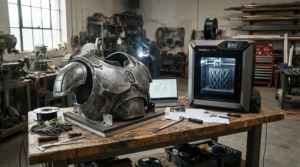
Prop making is arguably where a large resin printer for props earns its keep fastest. A full helmet, gauntlet, or chest piece that would otherwise be split into four to eight sections — each requiring careful alignment, gap-filling, and sanding to hide the seam — prints as a single clean piece on machines like the Phrozen Sonic Mega 8K S or Peopoly Phenom Forge, both offering genuine 300mm-plus Z-height.
What most cosplayers overlook is that seamless printing doesn’t just save time, it also improves structural integrity — a glued seam is a weak point under the stress of convention wear, while a single-piece print has no such fault line. Reviewers who print full helmets regularly note that the time saved in post-processing alone can offset the higher upfront cost of a large-format machine within a handful of projects, particularly for anyone taking paid commissions. For detail-critical pieces like faceplates and visors, pairing that build volume with a high-resolution screen — the Anycubic Photon Mono M7 Max‘s 12K panel is a strong middle ground — keeps fine surface texture crisp even at prop scale.
Resin Printers for Batch Printing: Cost & Workflow
A resin printer for batch printing lives or dies on one metric: cost and time per finished part, not per print job. The Phrozen Sonic Mega 8K S illustrates this well — its 80-miniature capacity per run means a print job that takes roughly 10 hours at full height produces enough stock for weeks of Etsy or tabletop-gaming orders, rather than a single evening’s output on a small desktop machine.
The maths only works, though, if your exposure profile is properly calibrated for consistent curing across the whole plate — an uncalibrated large vat wastes far more resin on failed edge prints than a small one ever could. Reviewers running these machines commercially consistently flag calibration and a reliable slicer workflow (many prefer Lychee or ChituBox over bundled software) as the difference between genuine batch-printing efficiency and a very expensive way to fail 80 miniatures at once instead of ten.
Long-Term Cost & Maintenance: Total Cost of Ownership
The printer’s price tag is only the opening bid. Resin, FEP film replacements, isopropyl alcohol for washing, and eventual screen replacement all add up, and they scale with build volume.
| Cost Factor | Budget Pick (Jupiter SE) | Premium Pick (Phenom Forge) |
|---|---|---|
| Printer price range | around £450-£550 | £1,600-£1,800 range |
| Resin per full plate | ~1 litre | 2-3 litres |
| FEP film lifespan | Standard, moderate cost | Heavier-duty, similar swap cost |
| Screen replacement cost | Lower (6K panel) | Higher (specialist panel) |
Analysing the table, the gap in upfront price between the Elegoo Jupiter SE and Peopoly Phenom Forge is roughly three to four times, but the gap in resin consumption per full-plate print is smaller than that ratio suggests — meaning the total cost of ownership narrows considerably once you’re printing at genuine volume on either machine. Reviewers running production-grade printers note that screen and FEP replacement costs, not resin, tend to be the recurring expense buyers underestimate most.
When a machine finally reaches end of life, don’t simply bin it. Under UK rules, printers count as waste electrical and electronic equipment, and any WEEE containing hazardous components must be stored safely, kept separate from ordinary waste, and treated at an authorised facility — NetRegs’ guidance on disposing of hazardous WEEE is a useful starting point if you’re upgrading and need to dispose of an old unit responsibly.
Safety, Ventilation & UK Regulations Guide
Resin printing carries real, manageable risks that scale with build volume. Uncured resin can irritate skin and eyes, so nitrile gloves and eye protection are non-negotiable regardless of which of these seven printers you choose. Beyond PPE, ventilation is where large-format machines demand more attention than small desktop units — a bigger vat and bigger plate simply mean more surface area releasing VOCs during printing and post-curing.
Official guidance in this area, while still developing, consistently recommends the precautionary principle: control exposure at source rather than waiting for conclusive long-term evidence. Waste electrical and electronic equipment is regulated in the UK under the WEEE Regulations 2013, which cover the printer itself once it reaches end of life, and separately, HSE’s guidance on waste electrical and electronic equipment outlines the broader legal framework for handling this category of waste responsibly.
Practically, that means: print in a ventilated room, ideally with the machine’s lid closed during operation (all seven models here include an enclosure or flip-lid), wash prints in a well-ventilated area or outdoors where possible, and cure waste resin in the sun or with a UV lamp before disposing of it as solid, cured plastic rather than liquid hazardous waste.
FAQ
❓ What build volume counts as a large-format resin printer?
❓ How much resin does a large-format printer use per print?
❓ Do I need special ventilation for a big build volume resin printer?
❓ Which large-format resin printer is best for batch printing miniatures?
❓ Is a large resin printer for props worth it over splitting the model?
Conclusion
Choosing a large-format resin 3D printer really comes down to matching the machine to the job, not chasing the biggest number on the spec sheet. If you’re dipping a toe in for the first time, the Elegoo Jupiter SE or Anycubic Photon M3 Max get you real build volume without a painful outlay. If you want one printer that handles everything from props to painted minis, the Anycubic Photon Mono M7 Max and Elegoo Jupiter 2 are the strongest all-rounders here. And if your work is genuinely commercial — batch runs, client props, or daily production — the Phrozen Sonic Mega 8K S and Peopoly Phenom Forge are built to survive that workload without complaint.
Whichever you choose, remember that the printer is only half the running cost: budget for resin, ventilation, and consumables from day one, and check current prices before buying, since they shift regularly. Every one of these seven machines earns its place on this list for a genuine reason — the right one for you depends on what’s currently splitting into pieces on your workbench.
Recommended for You
- High-Resolution Resin 3D Printer for Miniatures: 7 Best Picks (2026)
- DLP Resin 3D Printer: 7 Sharp Picks for UK Makers (2026)
- MSLA Resin 3D Printer: 7 Best Picks for UK Makers (2026)
Disclaimer: This article contains affiliate links. As an Amazon Associate, I earn from qualifying purchases. If you purchase products through these links, we may earn a small commission at no additional cost to you.
✨ Found this helpful? Share it with your friends! 💬🤗
